Conversion optimization is now a recognized discipline in the digital marketing stack. This stack roughly looks like this:
Brand Development
Awareness Advertising
Web Property Development
Search Marketing
Conversion Optimization
Loyalty and Evangelism
According to MarketingCharts.com, increasing conversion rates is at the top of business’s digital priorities in 2014.
“Testing and Optimization” is in the top three of 21% of respondents to this survey. As it turns out, test data is ideal for “Leveraging actionable data”, which 21% also put in their top three.
For most businesses, the digital marketing stack is delivered by one or more digital agencies. When is the right time for these agencies to begin offering conversion optimization services? We think it’s now, and we’d like to provide you with this capability. When I talk about conversion optimization, I mean the following process:
Analyzing a property and its data.
Identifying issues and opportunities to increase the performance.
Testing to identify what increasing leads, subscribers and sales.
In our experience, it is wholly insufficient to stop with step 2. Step 3 provides the measureable revenue increases that these services deliver.
Conversion Optimization Delights Clients
We know you are being asked by your clients to provide conversion optimization services. Instead of saying, “We don’t do that,” you should take this chance to demonstrate your ability to help them find more revenue in measureable ways. Send them to Conversion Sciences.
We have an impressive track record.
Our basic process has increased revenue at every one of our clients.
Nine out of ten of our clients continue with us after our initial “Catalyst” process.
Our long-term clients experience doubled and tripled conversion rates.
Many of our happiest clients are referrals from agencies like yours.
We can deliver a complete turnkey optimization solution to your clients today.
Send Us the Business
If your clients are asking about conversion optimization, we say, “Send them our way.”
Call us now and we’ll give you detailed insight into our process and referral agreements.
Conversion Sciences
+1 (888) 961-6604 Toll Free
+1 (512) 961-7159 Direct bmassey@conversionsciences.com
Thanks to Peep Laja for the pointer to the MarketingCharts.com data.
Ghostbusters was a touchstone for us. Seven years ago, we were launching into a new marketplace – conversion optimization. Like the Ghostbusters, many didn’t understand the value of what we did. Like the ghosts of the movie, the goblins in a website were invisible and ethereal.
So, we turned up the volume, donning lab coats and teaching anyone who would listen. Today, conversion optimization is quickly becoming a must-have discipline in any online business.
We have always taken inspiration from the trio of Venkman, Stantz and Spengler, collectively known as the Ghostbusters.
To celebrate the 30th anniversary of the release of the Ghostbusters movie, we offer nine important lessons that we’ve taken from this classic comedy.
1. Get Yourself Some Cool Toys
“It’s technical. It’s one of our little toys.”
Batman had the Bat Cave. Ghostbusters had ECTO-1. We have CRO-1.
For us, we have to be able to bring our tools of choice to our clients. You probably don’t need the mobility that we do, but should have your own digital lab, stocked with the latest toys.
This modified ambulance carries some cool CRO tools.
For us, we require a solid analytics setup to build on. We further like to add some click tracking tools to see how visitors are interacting with pages. Our split testing software allows us to segment visitors into tests and to inject JavaScript into their experiences.
In the past, we’ve used session recorders and eye-tracking software to get more info on how visitors are using a site.
Yes, we think these are pretty cool toys. You will too when you wield them with a little finesse.
2. Save Your Tests
“Please understand. This is a high-voltage laser containment system.”
The Ghostbusters went on quite a hunting spree in the first movie capturing all manner of ghost, ghoul and specter. What did they do with these? They placed them in a high-voltage laser containment system.
When you complete a test on your website, you need to save the results in a place that ensures you won’t forget what you’ve learned.
Store your tests where they can have the most impact.
We’ve never had a one-size-fits-all approach to documenting test results. We’ve used physical books that we call “Books of Swagger” so that our clients have the answers to questions at their fingertips.
We’ve kept detailed spreadsheets of tests.
Today, we rely most frequently on PowerPoint decks to save our “swagger” along with the details of the tests in our split testing tools.
3. Realize You’re Saving the World
“Fire and brimstone coming down from the sky! Rivers and seas boiling! Forty years of darkness! Earthquakes! Volcanoes! The dead rising from the grave! Human sacrifice, dogs and cats living together — mass hysteria!”
Don’t underestimate the magnitude of the shift you’re bringing to your online business. Adding some science to your marketing is going to bring profound changes to your organization.
Decisions will be made differently. Old beliefs, superstitions and sacred cows will disintegrate.
It will be painful at times and will take some passionate convincing of doubters. In the end, you could be saving the business.
4. Get Some Strange Hobbies
“I collect molds, spores and fungus.”
You’ve got to be interested in some strange topics. Revenue per visit, statistical significance, correlation vs. causation… it’s quite different from product, positioning and pricing.
Yes, the geeks are going to rule the marketing world, so get your geek on.
CRO geeks are interested in the psychology of influence, the structure of the mind and in rudimentary statistics. We study images, copywriting, pricing theory and user experience theory.
The bottom line is that you are going to have to nurture an interest in some unusual topics to be a well-rounded online marketing scientist.
5. Clear Your Mind
“It’s the Stay Puft Marshmallow Man.”
Expectations and attachments will dull your ability to apply science to your marketing. Often, our most cherished creative just won’t win in a split test.
I’m not saying that you shouldn’t have goals for your tests. However, expectations and attachments to outcomes can lead to poor decision-making.
If you’re sure a certain treatment is going to win in a split test, you’re more likely to call it a winner before the confidence level is high enough.
If you expect your results to “make sense”, you are more likely to throw out valid results as “unexplainable.”
We find that it is harder to come up with new hypotheses for a site we’ve been working on for a year or more. It’s harder to clear our minds of the knowledge we already have.
The more you know a thing, the less meaning it has for you. Clear your mind.
6. Don’t Cross the Streams
“Try to imagine all life as you know it ending instantaneously and every molecule in your body exploding at the speed of light.”
Don’t cross your traffic streams when doing multiple tests on a site.
The more tests we can run on a site, the faster we learn. Sites with a large number of visitors and conversions can run several tests, provided the audience can be segmented.
The idea of testing is to understand what is working and what is not. To do this, we need to isolate variables. This is science talk for “only change one thing at a time.” Ideally, only one thing will change for any visitor to your site.
However, if you allow a group of visitors to enter multiple tests, then more than one thing is changing. Imagine that a visitor comes to the home page and is entered into a test in which you remove the sidebar menu. Then they come to a test in your shopping cart in which you remove the discount code field.
When the tests are done, you won’t know which combination of home page sidebar and discount code field resulted in the most sales. The data for both tests have been polluted and cannot be relied on.
So, don’t cross your streams of traffic. If you are running multiple tests on a site, be sure that you segment traffic to only see one or the other.
7. Be Proud to be a Scientist
“Back off man. I’m a scientist.”
You should feel proud to have a data-driven marketing program up and running. Science isn’t perfect, and the fact that we are always trying to prove ourselves wrong means that our self-esteem may suffer.
Most importantly, you should be bringing others in your organization along the science learning curve.
Don’t be afraid to take a moment to explain statistical significance to a coworker. Go ahead and write up a memo on isolating variables or calculating the length of a test.
And when you have a success, be sure to do the money-dance in a very public way.
8. Tell Them About the Twinkie
“That’s a big Twinkie.”
At one point in our heroes’ adventures, Dr. Spengler uses a Twinkie to illustrate the growth of “psychokinetic energy” in the New York area.
“According to this morning’s sample, it would be a Twinkie 35 feet long weighing 600 pounds.”
Spengler uses a Twinkie to illustrate the ghostly trouble brewing in New York.
We really can’t take our graphs, charts and tables out to our organizations and expect others the understand what we’re seeing.
I think this is why we prefer to save our test results in slide decks. It is a system designed to tell an emerging story. These decks includes hypotheses, screen shots, data tables and conclusions. Everyone can open them and they can be as big as they need to be.
Sometimes, a map is better than step-by-step directions. Become a student of explaining and presenting findings. The better you get at this, the more cred you will build within your company.
Companies like Narrative Sciences are focused on turning data into stories.
Use your own Twinkies – analogies and metaphors – to help others understand the context for your discoveries and their relevance to themselves.
Charles Bukowski said, “Genius could be the ability to say a profound thing in a simple way.”
9. Don’t get Slimed
“I feel so funky.”
Don’t let the slime get you down.
It is one of the inevitabilities of the scientist to have her most amazing theories regularly proven wrong. Inconclusive tests, polluted data and external interference make testing disheartening.
Don’t let a series of disappointments bring your momentum and scientific excitement to a standstill. Don’t let yourself get slimed.
If you find yourself in a slump, it’s time to get input from outside of your echo-chamber. Pull in some fresh eyes from elsewhere in the company. Watch a few recorded sessions or collect some user feedback using any of a number of tools.
When you feel your energy ebbing, it’s because you got attached to your outcomes. Be humble. Stay curious. Stay out of the slime.
Thanks to Dan Akroyd, Rick Moranis, Bill Murray and the late Harold Ramis for providing the inspiration we needed to take ourselves a little less seriously than we would have.
Are you troubled by high bounce rates in the middle of the night? Do you experience feelings of dread in your CFO’s office? Have you or your family ever seen you twitch, shake or cry? If the answer is “yes,” then don’t wait another minute. Pick up the phone and call the professionals.
Images taken from Ghostbusters. All copyrights belong to their owners.
Should I waste my time on Facebook advertising or throw all my eggs into the blogging basket this year? What social media marketing trends do I need to integrate into my marketing?
The 2014 Social Media Marketing Industry Report holds results from over 2,800+ marketers. These experts share their experience with new and rising trends in social media marketing. The following infographic will answer marketers questions concerning where to focus their efforts in social media marketing this year.
Some relevant takeaways from the following infographic and Social Media Examiner article:
Over half of the marketers (58%) surveyed chose original written content as their most important form of social media content.
68% of marketers plan to increase their future use of blogging.
Only 6% of marketers podcast, with 28% wanting to learn more about it.
68% of marketers are using social media for 6 hours or more a week.
The staff was assembled, the stage was set. Representatives from every department plus some of the big brass were sitting around the long conference table.
I was about to present the data that showed how successful my marketing campaigns had been for the past month. This was important, because it had been like pulling teeth to get a more data-driven process in place.
IT had to be cajoled into setting up Google Analytics.
Sales had to be bullied into keeping good account of leads and sales.
Now, with the first full month of data in hand, I was going to point to some steady growth. My pitch was confident as I showed the increase in leads and correlated it with an increase in sales. I was going to be a star.
Until someone spoke up from sales.
“We didn’t get that many leads last month. Most of my sales came from affiliates.”
All eyes turned to me. What I would say next would either raise stature or destroy my credibility. Was it my programs, or was it my analytics that caused this disconnect?
The right answer would have been, “I personally QA’d our analytics setup. These numbers are right.”
Could you have given that answer?
In my most recent Marketing Land article Is It The Site, Or Is It The Analytics? Debugging Google Analytics, I show you how to be certain that your Google Analytics setup is working as planned.
Whether you setup your own analytics or have your tech team do it, you need to know that the data you’re using is right.
There is a point in almost every testing program in which your confidence will be shaken. Even seasoned professionals experience it.
We start off with high confidence having identified opportunities to really improve a site. We’re good at getting that low-hanging fruit early on, but we will inevitably find that many of our great ideas just don’t work.
It’s humbling, the right kind of humbling.
With patience, our picture of the visitors coming to a site become clearer. On-going success is due not to our own brilliance, but to what we learn in the Valley of Death that kills so many testing programs before they’ve matured.
We can take you through the Valley of Death. Have a conversation with a Conversion Scientist this week to see what our testing team can do for your bottom line.
Color preferences are deeply rooted emotional responses that seem to lack any rational basis, yet the powerful influence of color rules our choices in everything from the food we eat to the clothes we wear to the cars we buy.
One study found that magazine readers recognize full-color ads 26% more often than black-and-white ads.
92.6% of people say the visual dimension is the #1 influencing factor affecting their purchase decision (over taste, smell, etc.).
2 out of 3 consumers will not buy a large appliance unless it comes in their favorite color.
Color has a powerful psychological influence on the human brain. Others have used color to their advantage and now you can do the same. Check out this infographic by our friends at KISSmetrics.
The Strongest Online Persuader You’ll Ever Encounter: Yourself
The things that make us effective marketers or stand in our way often aren’t external, but internal. Being a good marketer, copywriter or Conversion Scientist means coming to terms with our own demons, limitations and neuroses.
Dr. Aaron Balick maps out how our overburdened Ego does it’s best “while being goaded on by the Id and being told off by the Superego.”
Dr. Balick knows how to help us relate to these kind of issues in his latest article.
Why The New Google Search Ads Design Is a Subtle Work of Genius
If you didn’t know, Google has redesigned their search results pages recently. The change is primarily to the portion of the page that contains “sponsored content”, or ads.
The eye-tracking images provided by the folks at EyeQuant are telling.
The pages now drive more attention to the ads, taking attention away from the free results. Ironically, it also makes the ads more evident, with a bright icon beside each.
EyeQuant calls this “a Subtle Work of Genius”. What do you think?
11 A/B Split Testing Mistakes I See Businesses Make All The Time
Peep Laja has put into one blog post most of the hard lessons we’ve learned over the years of testing here in the Conversion Lab. Peep doesn’t mince words (“There is no best color”).
Don’t let all of this scare you. It’s better to try and learn from your mistakes than to not make any mistakes at all. Test away! Read Peep Laja’s article in its entirety here.
Are you a CRO Junkie? It Could Ruin Your Split Tests
Do you get a shot of adrenaline every time you see an uptick in conversions? We do. However, we often find our early excitement tempered when a test turns out to be inconclusive.
It can be hard to announce to a customer that you didn’t find a winner. In fact, it’s a discipline here.
Find out what you can do to keep from getting addicted to good test results.
Want to get Brian’s For Further Study posts delivered right to your inbox?
I have to admit, I was a little more nervous than usual presenting in front of an audience of psychologist-marketers.
You’ll see what I mean in the video.
Why would a Conversion Scientist be invited to speak at a Psych conference? Because our testing is designed to tell us things about your visitors that they cannot even explain themselves. This is why split testing is such a valuable tool. Visitors tell us what they prefer by how they act.
One thing testing has taught us is that there are bouncers in the human brain, and these bouncers must be dealt with before our messages will be processed and acted upon.
It’s just 20 minutes or so.
Hat tip to Roy H. Williams and the Wizard Academy for introducing me to the research I present here.
Sometime in the next eight days, Conversion Sciences will have published the 300th article on The Conversion Scientist blog.
Don’t get lost in the content that flows from this blog.
Every one of them is amazing, of course. While some of them were written by amazing guest contributors, I combed through over 200 of them to find the nine that I think you should read now. So important are these nine, that we are willing to give you a free review of your website by one of our best Conversion Scientists if you read them all. I know you have some burning questions.
How is my site performing compared to my competitors?
Is there anything fundamentally wrong with my pages?
What is the first thing I should change to increase leads and sales?
How do I prioritize all of the marketing campaigns I have on my plate?
If one or more of these questions aren’t on your mind, we have to ask, “Why not?” These are the questions we seek to answer during your review. But you have to earn your Ph.D. badge first.
How to get your formal website review
When you visit The Conversion Scientist blog and sign up for the free course we’ll take you through the chosen articles. When you read, you will be awarded points. Some of the articles include audio for your commute to and from work. All in all, you be able to finish the course in an hour or so. Then you’ll be ready.
Sign up now. Start collecting points and earning badges.
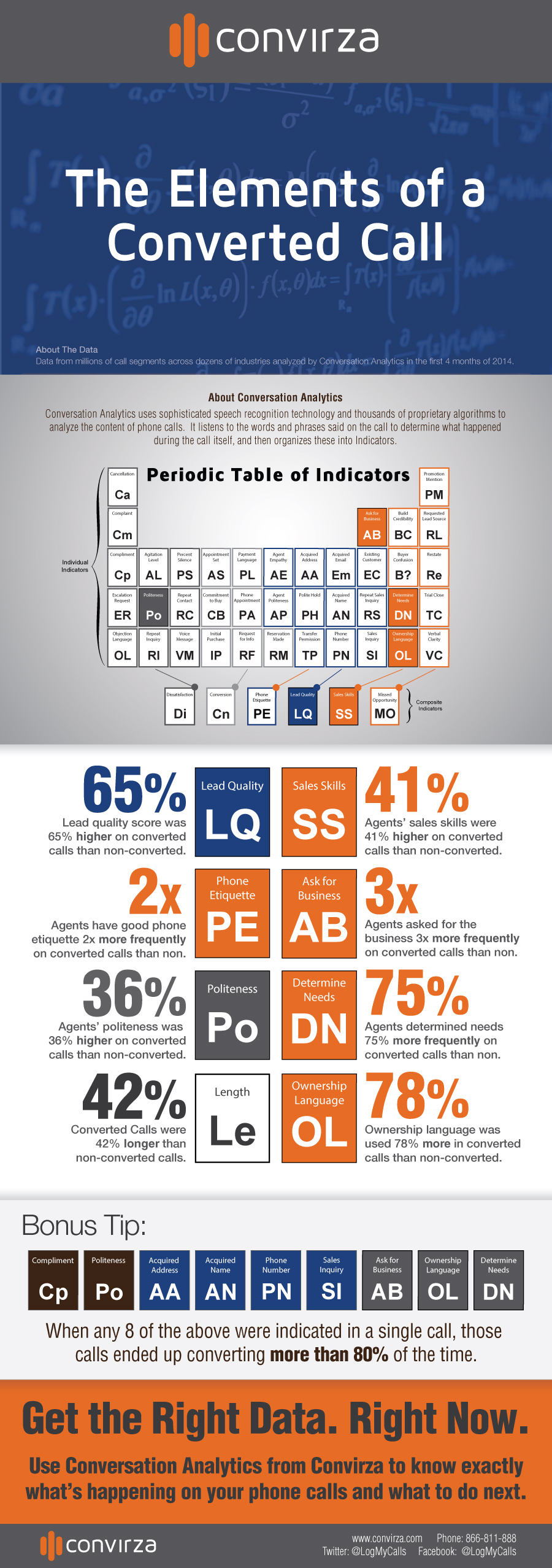
Here we thought we were the only ones who loved a good periodic table. Data collected from Convirza based on millions of phone calls analyzed in the first quarter of 2014 answers the critical question: what are the differences between a converted call and a non-converted call?
McKay Allen shared the results from this study in this incredible infographic. Some interesting facts you will find:
Agents asked for the business 3x more frequently on converted calls than non.
Converted calls were 42% longer than non-converted calls.
Lead quality score was 65% higher on converted calls than non.


Agencies are being asked for Conversion Optimization Services
Conversion OptimizationConversion optimization is now a recognized discipline in the digital marketing stack. This stack roughly looks like this:
According to MarketingCharts.com, increasing conversion rates is at the top of business’s digital priorities in 2014.
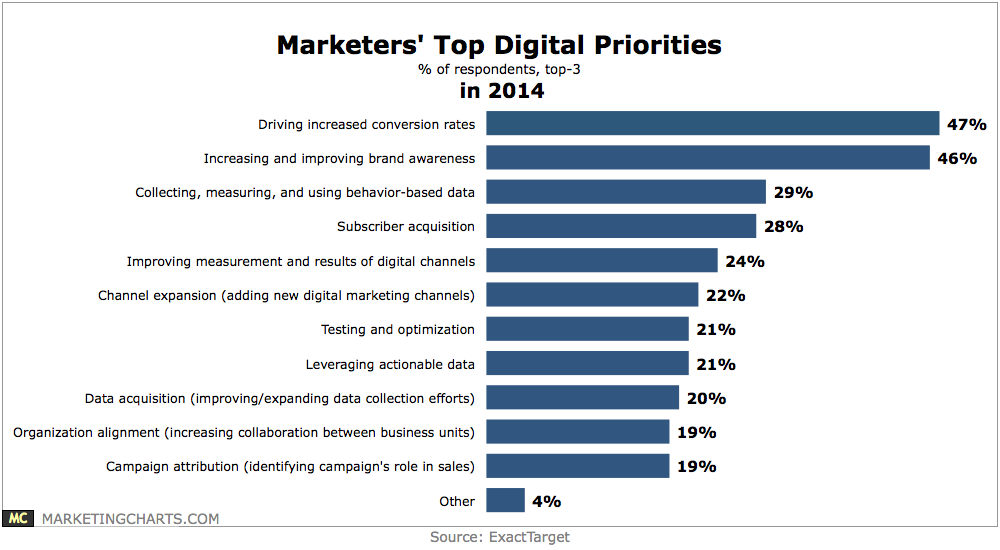
“Testing and Optimization” is in the top three of 21% of respondents to this survey. As it turns out, test data is ideal for “Leveraging actionable data”, which 21% also put in their top three.
For most businesses, the digital marketing stack is delivered by one or more digital agencies.
When is the right time for these agencies to begin offering conversion optimization services? We think it’s now, and we’d like to provide you with this capability. When I talk about conversion optimization, I mean the following process:
In our experience, it is wholly insufficient to stop with step 2. Step 3 provides the measureable revenue increases that these services deliver.
Conversion Optimization Delights Clients
We know you are being asked by your clients to provide conversion optimization services. Instead of saying, “We don’t do that,” you should take this chance to demonstrate your ability to help them find more revenue in measureable ways. Send them to Conversion Sciences.
We have an impressive track record.
We can deliver a complete turnkey optimization solution to your clients today.
Send Us the Business
If your clients are asking about conversion optimization, we say, “Send them our way.”
Call us now and we’ll give you detailed insight into our process and referral agreements.
Conversion Sciences
+1 (888) 961-6604 Toll Free
+1 (512) 961-7159 Direct
bmassey@conversionsciences.com
Thanks to Peep Laja for the pointer to the MarketingCharts.com data.
9 Motivational CRO Lessons You Can Learn from Ghostbusters
Conversion OptimizationGhostbusters was a touchstone for us. Seven years ago, we were launching into a new marketplace – conversion optimization. Like the Ghostbusters, many didn’t understand the value of what we did. Like the ghosts of the movie, the goblins in a website were invisible and ethereal.
So, we turned up the volume, donning lab coats and teaching anyone who would listen. Today, conversion optimization is quickly becoming a must-have discipline in any online business.
We have always taken inspiration from the trio of Venkman, Stantz and Spengler, collectively known as the Ghostbusters.
To celebrate the 30th anniversary of the release of the Ghostbusters movie, we offer nine important lessons that we’ve taken from this classic comedy.
1. Get Yourself Some Cool Toys
“It’s technical. It’s one of our little toys.”
Batman had the Bat Cave. Ghostbusters had ECTO-1. We have CRO-1.
For us, we have to be able to bring our tools of choice to our clients. You probably don’t need the mobility that we do, but should have your own digital lab, stocked with the latest toys.
This modified ambulance carries some cool CRO tools.
For us, we require a solid analytics setup to build on. We further like to add some click tracking tools to see how visitors are interacting with pages. Our split testing software allows us to segment visitors into tests and to inject JavaScript into their experiences.
In the past, we’ve used session recorders and eye-tracking software to get more info on how visitors are using a site.
Yes, we think these are pretty cool toys. You will too when you wield them with a little finesse.
2. Save Your Tests
“Please understand. This is a high-voltage laser containment system.”
The Ghostbusters went on quite a hunting spree in the first movie capturing all manner of ghost, ghoul and specter. What did they do with these? They placed them in a high-voltage laser containment system.
When you complete a test on your website, you need to save the results in a place that ensures you won’t forget what you’ve learned.
Store your tests where they can have the most impact.
We’ve never had a one-size-fits-all approach to documenting test results. We’ve used physical books that we call “Books of Swagger” so that our clients have the answers to questions at their fingertips.
We’ve kept detailed spreadsheets of tests.
Today, we rely most frequently on PowerPoint decks to save our “swagger” along with the details of the tests in our split testing tools.
3. Realize You’re Saving the World
“Fire and brimstone coming down from the sky! Rivers and seas boiling! Forty years of darkness! Earthquakes! Volcanoes! The dead rising from the grave! Human sacrifice, dogs and cats living together — mass hysteria!”
Don’t underestimate the magnitude of the shift you’re bringing to your online business. Adding some science to your marketing is going to bring profound changes to your organization.
Decisions will be made differently. Old beliefs, superstitions and sacred cows will disintegrate.
It will be painful at times and will take some passionate convincing of doubters. In the end, you could be saving the business.
4. Get Some Strange Hobbies
“I collect molds, spores and fungus.”
You’ve got to be interested in some strange topics. Revenue per visit, statistical significance, correlation vs. causation… it’s quite different from product, positioning and pricing.
Yes, the geeks are going to rule the marketing world, so get your geek on.
CRO geeks are interested in the psychology of influence, the structure of the mind and in rudimentary statistics. We study images, copywriting, pricing theory and user experience theory.
The bottom line is that you are going to have to nurture an interest in some unusual topics to be a well-rounded online marketing scientist.
5. Clear Your Mind
“It’s the Stay Puft Marshmallow Man.”
Expectations and attachments will dull your ability to apply science to your marketing. Often, our most cherished creative just won’t win in a split test.
I’m not saying that you shouldn’t have goals for your tests. However, expectations and attachments to outcomes can lead to poor decision-making.
If you’re sure a certain treatment is going to win in a split test, you’re more likely to call it a winner before the confidence level is high enough.
If you expect your results to “make sense”, you are more likely to throw out valid results as “unexplainable.”
We find that it is harder to come up with new hypotheses for a site we’ve been working on for a year or more. It’s harder to clear our minds of the knowledge we already have.
The more you know a thing, the less meaning it has for you. Clear your mind.
6. Don’t Cross the Streams
“Try to imagine all life as you know it ending instantaneously and every molecule in your body exploding at the speed of light.”
Don’t cross your traffic streams when doing multiple tests on a site.
The more tests we can run on a site, the faster we learn. Sites with a large number of visitors and conversions can run several tests, provided the audience can be segmented.
The idea of testing is to understand what is working and what is not. To do this, we need to isolate variables. This is science talk for “only change one thing at a time.” Ideally, only one thing will change for any visitor to your site.
However, if you allow a group of visitors to enter multiple tests, then more than one thing is changing. Imagine that a visitor comes to the home page and is entered into a test in which you remove the sidebar menu. Then they come to a test in your shopping cart in which you remove the discount code field.
When the tests are done, you won’t know which combination of home page sidebar and discount code field resulted in the most sales. The data for both tests have been polluted and cannot be relied on.
So, don’t cross your streams of traffic. If you are running multiple tests on a site, be sure that you segment traffic to only see one or the other.
7. Be Proud to be a Scientist
“Back off man. I’m a scientist.”
You should feel proud to have a data-driven marketing program up and running. Science isn’t perfect, and the fact that we are always trying to prove ourselves wrong means that our self-esteem may suffer.
Most importantly, you should be bringing others in your organization along the science learning curve.
Don’t be afraid to take a moment to explain statistical significance to a coworker. Go ahead and write up a memo on isolating variables or calculating the length of a test.
And when you have a success, be sure to do the money-dance in a very public way.
8. Tell Them About the Twinkie
“That’s a big Twinkie.”
At one point in our heroes’ adventures, Dr. Spengler uses a Twinkie to illustrate the growth of “psychokinetic energy” in the New York area.
“According to this morning’s sample, it would be a Twinkie 35 feet long weighing 600 pounds.”
Spengler uses a Twinkie to illustrate the ghostly trouble brewing in New York.
We really can’t take our graphs, charts and tables out to our organizations and expect others the understand what we’re seeing.
I think this is why we prefer to save our test results in slide decks. It is a system designed to tell an emerging story. These decks includes hypotheses, screen shots, data tables and conclusions. Everyone can open them and they can be as big as they need to be.
Sometimes, a map is better than step-by-step directions. Become a student of explaining and presenting findings. The better you get at this, the more cred you will build within your company.
Companies like Narrative Sciences are focused on turning data into stories.
Use your own Twinkies – analogies and metaphors – to help others understand the context for your discoveries and their relevance to themselves.
Charles Bukowski said, “Genius could be the ability to say a profound thing in a simple way.”
9. Don’t get Slimed
“I feel so funky.”
Don’t let the slime get you down.
It is one of the inevitabilities of the scientist to have her most amazing theories regularly proven wrong. Inconclusive tests, polluted data and external interference make testing disheartening.
Don’t let a series of disappointments bring your momentum and scientific excitement to a standstill. Don’t let yourself get slimed.
If you find yourself in a slump, it’s time to get input from outside of your echo-chamber. Pull in some fresh eyes from elsewhere in the company. Watch a few recorded sessions or collect some user feedback using any of a number of tools.
When you feel your energy ebbing, it’s because you got attached to your outcomes. Be humble. Stay curious. Stay out of the slime.
Thanks to Dan Akroyd, Rick Moranis, Bill Murray and the late Harold Ramis for providing the inspiration we needed to take ourselves a little less seriously than we would have.
Are you troubled by high bounce rates in the middle of the night?
Do you experience feelings of dread in your CFO’s office?
Have you or your family ever seen you twitch, shake or cry?
If the answer is “yes,” then don’t wait another minute. Pick up the phone and call the professionals.
Images taken from Ghostbusters. All copyrights belong to their owners.
7 Social Media Marketing Trends [INFOGRAPHIC]
Conversion-Centered DesignShould I waste my time on Facebook advertising or throw all my eggs into the blogging basket this year? What social media marketing trends do I need to integrate into my marketing?
The 2014 Social Media Marketing Industry Report holds results from over 2,800+ marketers. These experts share their experience with new and rising trends in social media marketing. The following infographic will answer marketers questions concerning where to focus their efforts in social media marketing this year.
Some relevant takeaways from the following infographic and Social Media Examiner article:
Enjoy and share!
Social media marketing trends for 2014 from Social Media Examiner.
Looking to gain more from your library of original content? Breath new life into your webinars and start generating leads today.
3 Must Have Tools for Those Who Depend on Google Analytics [AUDIO]
Lead GenerationThe staff was assembled, the stage was set. Representatives from every department plus some of the big brass were sitting around the long conference table.
I was about to present the data that showed how successful my marketing campaigns had been for the past month. This was important, because it had been like pulling teeth to get a more data-driven process in place.
IT had to be cajoled into setting up Google Analytics.
Sales had to be bullied into keeping good account of leads and sales.
Now, with the first full month of data in hand, I was going to point to some steady growth. My pitch was confident as I showed the increase in leads and correlated it with an increase in sales. I was going to be a star.
Until someone spoke up from sales.
“We didn’t get that many leads last month. Most of my sales came from affiliates.”
All eyes turned to me. What I would say next would either raise stature or destroy my credibility.
Was it my programs, or was it my analytics that caused this disconnect?
The right answer would have been, “I personally QA’d our analytics setup. These numbers are right.”
Could you have given that answer?
In my most recent Marketing Land article Is It The Site, Or Is It The Analytics? Debugging Google Analytics, I show you how to be certain that your Google Analytics setup is working as planned.
Whether you setup your own analytics or have your tech team do it, you need to know that the data you’re using is right.
Listen to the Article, Read by the Author
Podcast: Play in new window | Download
Subscribe
The More I Test the More I Loathe Myself
CRO Tests | Multivariate | AB TestingThere is a point in almost every testing program in which your confidence will be shaken. Even seasoned professionals experience it.
We start off with high confidence having identified opportunities to really improve a site. We’re good at getting that low-hanging fruit early on, but we will inevitably find that many of our great ideas just don’t work.
It’s humbling, the right kind of humbling.
With patience, our picture of the visitors coming to a site become clearer. On-going success is due not to our own brilliance, but to what we learn in the Valley of Death that kills so many testing programs before they’ve matured.
We can take you through the Valley of Death.
Have a conversation with a Conversion Scientist this week to see what our testing team can do for your bottom line.
Inspired by the excellent blog Indexed.
Would You Drink Brown Orange Juice? How Colors Affect Conversions [INFOGRAPHIC]
Conversion OptimizationColor preferences are deeply rooted emotional responses that seem to lack any rational basis, yet the powerful influence of color rules our choices in everything from the food we eat to the clothes we wear to the cars we buy.
Color has a powerful psychological influence on the human brain. Others have used color to their advantage and now you can do the same. Check out this infographic by our friends at KISSmetrics.
Source: How Colors Affect Conversions – Infographic
Are You a CRO Junkie and More – For Further Study
Conversion OptimizationThe Strongest Online Persuader You’ll Ever Encounter: Yourself
The things that make us effective marketers or stand in our way often aren’t external, but internal. Being a good marketer, copywriter or Conversion Scientist means coming to terms with our own demons, limitations and neuroses.
Dr. Aaron Balick maps out how our overburdened Ego does it’s best “while being goaded on by the Id and being told off by the Superego.”
Dr. Balick knows how to help us relate to these kind of issues in his latest article.
Why The New Google Search Ads Design Is a Subtle Work of Genius
If you didn’t know, Google has redesigned their search results pages recently. The change is primarily to the portion of the page that contains “sponsored content”, or ads.
The eye-tracking images provided by the folks at EyeQuant are telling.
The pages now drive more attention to the ads, taking attention away from the free results. Ironically, it also makes the ads more evident, with a bright icon beside each.
EyeQuant calls this “a Subtle Work of Genius”. What do you think?
11 A/B Split Testing Mistakes I See Businesses Make All The Time
Peep Laja has put into one blog post most of the hard lessons we’ve learned over the years of testing here in the Conversion Lab. Peep doesn’t mince words (“There is no best color”).
Don’t let all of this scare you. It’s better to try and learn from your mistakes than to not make any mistakes at all. Test away!
Read Peep Laja’s article in its entirety here.
Are you a CRO Junkie? It Could Ruin Your Split Tests
Do you get a shot of adrenaline every time you see an uptick in conversions? We do. However, we often find our early excitement tempered when a test turns out to be inconclusive.
It can be hard to announce to a customer that you didn’t find a winner. In fact, it’s a discipline here.
Find out what you can do to keep from getting addicted to good test results.
Want to get Brian’s For Further Study posts delivered right to your inbox?
Click HERE to sign up.
Getting Past the Bouncers in our Brains- Chinwag Psych Conference Presentation
Persuasion ScienceI have to admit, I was a little more nervous than usual presenting in front of an audience of psychologist-marketers.
You’ll see what I mean in the video.
Why would a Conversion Scientist be invited to speak at a Psych conference? Because our testing is designed to tell us things about your visitors that they cannot even explain themselves. This is why split testing is such a valuable tool. Visitors tell us what they prefer by how they act.
One thing testing has taught us is that there are bouncers in the human brain, and these bouncers must be dealt with before our messages will be processed and acted upon.
It’s just 20 minutes or so.
Hat tip to Roy H. Williams and the Wizard Academy for introducing me to the research I present here.
References
Thinking, Fast and Slow by Daniel Kahneman
Albert Mehrabian on Amazon
21 Quick and Easy CRO Copywriting Hacks
Keep these proven copywriting hacks in mind to make your copy convert.
"*" indicates required fields
I Had to Write Over 200 Articles to Get These Nine – Conversion Course
News & EventsSometime in the next eight days, Conversion Sciences will have published the 300th article on The Conversion Scientist blog.
Don’t get lost in the content that flows from this blog.
Every one of them is amazing, of course. While some of them were written by amazing guest contributors, I combed through over 200 of them to find the nine that I think you should read now. So important are these nine, that we are willing to give you a free review of your website by one of our best Conversion Scientists if you read them all. I know you have some burning questions.
If one or more of these questions aren’t on your mind, we have to ask, “Why not?” These are the questions we seek to answer during your review. But you have to earn your Ph.D. badge first.
How to get your formal website review
When you visit The Conversion Scientist blog and sign up for the free course we’ll take you through the chosen articles. When you read, you will be awarded points. Some of the articles include audio for your commute to and from work. All in all, you be able to finish the course in an hour or so. Then you’ll be ready.
Sign up now. Start collecting points and earning badges.
The Elements of A Converted Call [INFOGRAPHIC]
Lead GenerationHere we thought we were the only ones who loved a good periodic table. Data collected from Convirza based on millions of phone calls analyzed in the first quarter of 2014 answers the critical question: what are the differences between a converted call and a non-converted call?
McKay Allen shared the results from this study in this incredible infographic. Some interesting facts you will find:
Please share and enjoy.
The Elements of a Converted Call
Conversion Sciences shows you how to get phone leads in our free Webinar with Convirza.