Use content to connect your social batteries to social landing pages and get customered. Improve your social media conversion rate. Read on
They friend you. They fan you. They pin you. They follow you.
BUT how often to they customer you? How often do they buy, subscribe, or register? How often can you get your fans and followers to convert?
When you get customered, your business grows, you gain another social influencer, and you get proof that your social media strategy is delivering what your social network wants.

They “liked” Me
BUT

They didn’t “customer” me.
Getting customered is an important part of the social media life cycle, and it’s also one of the trickiest. First, you need to recognize the potential within your social networks.
The possibilities Within Your Social Networks: Improving Your Social Media Conversion Rate
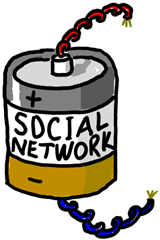
Your social networks store potential, like a battery stores voltage. What you need to do to charge your social battery:
- Get Noticed
- Get Liked
- Get Followed
- Get Connected
Sounds great, right? But, how do you hook up to the juice that turns that potential into leads and revenue? Tapping this potential requires that you connect your social battery to something of interest to both you and your social aficionados.
Use Content for Wires
As you know, there is a plethora of content out there and it comes in many forms. Content might be blog post links on Twitter, contests on Facebook, and product pictures on Pinterest. Without the content, no one is going to find their way back.
Many of us already have content strategies for our social networks, but what gets people to customer us when they visit? How can we get engage our customers?
Content. Content drives engagement.
Connect Them to Your Landing Pages
Unfortunately, once read, content is quickly dismissed. No matter how great your content is.
Keep in mind that most visitors spend only a few seconds on a new site deciding whether to engage further with the content or to click the “Back” button. So if your landing page is forming the bridge that introduces your new visitors to the rest of your site’s content, it’s vital that this page be as compelling as possible in getting new visitors to investigate further.
What is the next step for me as a visitor and potential customerer of your business?
The secret is to treat your content pages as social landing pages.
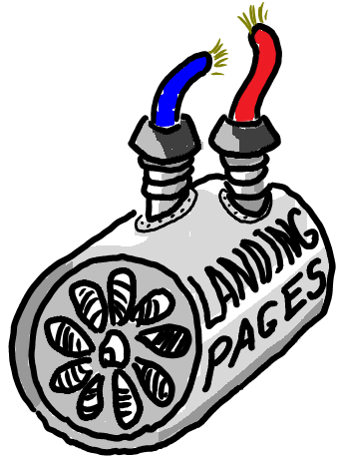 A landing page is a single minded page designed to do two things:
- Keep the promise made by the link that was clicked.
- Get the reader to do something that benefits them and your business.
A Social landing page, then, is a single minded page designed to:
- Deliver the content promised.
- Get the reader to customer you.
Both pages have content that delivers on a promise and a call to action that entices readers to do something wonderful.
Where do Social Landing Pages Live?
Social media landing pages live anywhere you are drawing social visitors.
- Your blog content pages have the content, but do they have the call to action? Is the call to action where it can be seen? – Add calls to action in or near the content.
- Your email signup pages have the call to action, but do they have the content that makes signing up appealing? – Give subscribers a better reason to sign up than “Get on another mailing list.”
- Your lead generation pages, offering gated content have the call to action, but do you talk about the content you are offering, or do you talk about our company and your products instead? – Any page to which your friends, fans and followers might come in search of education or entertainment qualified as a social media landing page.
- Product pages on eCommerce sites, are another frequent social media landing page. The call to action is invariably there: Add to Cart.
Ask yourself the following questions about your social landing pages:
- What content topics generate the most engaged visitors?
- Will more visitors comment if you simply ask them to?
- Where should your conversion beacons be: in the sidebar column, before or after the post or in the copy?
- What offers draw more clicks on your conversion beacons?
The Anatomy Of A Great Social Landing Page
Unlike its counterpart, the social landing page isn’t focused getting on one action from a visitor; it has to manage four different kinds of conversion. Do your social landing pages manage all four?
Social media strategies have become a boon to search marketers. Social media builds backlinks from authoritative sites, creates a stream of keyword-rich content and drives direct traffic to key pages.
While the “media” part of social media is almost completely free; the “social” part is quite expensive.
The “social” part of social media requires generating a steady menu of content and participating in the conversations generated around that content.
“Social” media isn’t cheap, but the things we do to generate great search engine results—creating content, encouraging conversations—are exactly the things that boost conversion rates and drive sales. This is what readers of this column are interested in.
Increasing conversion rates around social media requires that we change our tactics. I’m going to introduce you to the “social media landing page” and show you why you need to use this proven tool.
A different kind of conversion
For most of us, there is one kind of conversion. It happens when a visitor to our site fills out a form or completes a purchase. It is when a stranger becomes a prospect and a prospect becomes a customer.
In the realm of social media, a conversion can be quite different.
Dave Evans, in his book Social Media Marketing: An Hour a Day defines three stages that a social influencer must go through to create word-of-mouth messages for our businesses.
He starts with a small number of individuals who have purchased our products or services. Ironically, we have to “convert” these customers into users of our products, so that they have the authority to speak about our offering. We then help them form an opinion of us—preferably a favorable one—with the ultimate goal of getting them to talk about their experience.
We will also want to give those that hear these messages a way to interact with us.
Needless to say, a traditional landing page isn’t going to get us there. These pages are designed to entice action long after the post-purchase process has run its course.
Unlike its counterpart, the social media landing page isn’t focused getting on one action from a visitor; it has to do more.
Don’t worry: you probably see social landing pages every day. See if you can guess where I’m going with this.
Conversion to user
The social media landing page must educate a customer on how to use your product or offering in their situation. Therefore, the page must have an educational component.
Articles, videos and reviews with a “how to” or “10 ways to” orientation are classic examples, and you’re probably already generating such content for your search strategies.
Conversion to opinion-holder
It stands to reason that, if someone uses your product or service, they are going to form an opinion of it. However, studies tell us that “social proof” can often override personal experience in our perceptions. Therefore, a social landing page should expose the opinions of others.
Testimonials are the time-honored tactic for communicating social proof, but savvy social networkers want more specific, transparent and relevant commentary from people in their social graph. The social landing page must expose social gestures—comments, retweets, subscriptions and “likes”—to influencers seeking to make a statement with their opinion.
Conversion to talker
Once someone in authority has formed an opinion of our brand and offering, our landing page must provide them with a way to spread their message. Fortunately, there are myriad ways for visitors to our landing page to share their opinion, from comments to TweetMeme buttons.
Have you identified a page design that provides all of the moving parts outlined here? If you said a blog, a forum or a Facebook page, you are right on target. Each of these provides opportunities to educate visitors and allows influencers to spread the message through comments and posts.
Conversion beacons bring new visitors full circle
All of this will do little more than grow our social graph. How do we get new visitors—those influenced by our customers to consider our offering?
Conversion beacons tell visitors how to start interacting with us. These are classic offers, ads or forms that will often lead to traditional landing pages. These form the link back to the traditional sales funnel.
It is the conversion beacons that offer us a measurable way to calculate ROI, as these drive new leads and purchases.
Optimize your social landing pages and boost your social media conversion rate
Now that you know how important these pages are, give your blog or Facebook page another look.
Every good conversion scientist knows that testing is the quickest way to get better at online marketing, and the same is true for social landing pages. However, social landing pages aren’t as easy to test as traditional landing pages.
In my next column, I’ll show you the tools and tactics I use to measure the effectiveness of my social media marketing campaigns.
Original article on social media landing pages was published on Search Engine Land
Remember that these are Social Visitors
Given that your visitors are coming from a social network, they will be more likely to want to see social content with the product information. You should oblige them.
- Consider star ratings and reviews for your products.
- Use social proof. How many others have customered (bought) this product? How many friends, fans and followers do you have?
- Don’t invite them to become a friend, fan or follower. They already are. The only choice they should have is to customer you.
It’s one thing to get people to friend, fan, follow, and flatulate. It’s quite another to get them to customer you. Use content to connect your social batteries to social media landing pages and get customered.
Images by Brian Massey
Podcast: Play in new window | Download
“Getting Customered: Improving Your Social Media Conversion Rate” was recorded at Engage Mexico 2013 in Puerta Vallarta.
Can’t get enough? Download our
Get Customered: Social Media Conversion Rate PowerPoint Presentation.


How to Budget for Conversion Rate Optimization
Conversion OptimizationMore and more companies are putting Conversion Rate Optimization (CRO) into their online marketing budgets.
We like to call ourselves “The most measurable agency you’ll ever hire.” The reason is that we rely on analytics and testing to do our job. We have to know if we’re creating more revenue for a business. If we know you know.You should, too.
CRO — or website optimization, or revenue optimization — increases revenue, leads and subscribers. It also decreases the cost of all of your marketing. It reduces your acquisition cost by turning more visitors into leads and buyers.
However, CRO is one of the most measurable activities marketing will do.
Estimating Your Budget
The thing about conversion optimization is that small changes in conversion rate — we prefer to measure revenue per visit (RPV) — deliver big changes in sales. It can be hard to get your head around.
To help you understand the annual impact of small changes in your revenue per visit, we’ve created the Conversion Rate Upside Calculator. It will tell you how much more revenue you will make per year with small changes in your RPV.
The report tells you:
It’s a great report on the state of your online business, and the potential future you have in store.
Three Questions
Just three questions is all it takes to see how much your business will benefit from optimization.
Small changes in your conversion rate can mean big changes in your revenue. Give the optimization calculator a try.
Call us anytime at (888) 961-6604
Email us in the lab at
[hide_email TheLab@ConversionSciences.com]
*All data entered is kept confidential
President’s Money Marketing Math [Infograph]
Lead GenerationGeorge Washington. Abraham Lincoln. Ulysses S. Grant. Alexander Hamilton. Benjamin Franklin. Andrew Jackson.
We know their names. We know what they have done for the United States of America. Some were great Presidents who led the United States through epic battles, others broke through the barriers of segregation. One was the very first US Secretary of the Treasury. One even invented swim fins, the lightning rod, musical instruments, and bifocals; and that is just barely scratching the surface.
BUT did you know that ALL of them can help us with our money marketing math?
Which of these things are you looking at every month (or more often):
Your success depends on making high-dollar decisions. Benjamin Franklin also invented the concept of “paying it forward” and the President’s (and others) are here to do just that. Take a look at this infograph and ask yourself where you are in your Math Marketing Journey?
For more information, please read President’s Day Marketing Money Math.
Get Customered: Improving Your Social Media Conversion Rate [AUDIO]
Conversion OptimizationThey friend you. They fan you. They pin you. They follow you.
BUT how often to they customer you? How often do they buy, subscribe, or register? How often can you get your fans and followers to convert?
When you get customered, your business grows, you gain another social influencer, and you get proof that your social media strategy is delivering what your social network wants.
They “liked” Me
BUT
They didn’t “customer” me.
Getting customered is an important part of the social media life cycle, and it’s also one of the trickiest. First, you need to recognize the potential within your social networks.
The possibilities Within Your Social Networks: Improving Your Social Media Conversion Rate
Your social networks store potential, like a battery stores voltage. What you need to do to charge your social battery:
Sounds great, right? But, how do you hook up to the juice that turns that potential into leads and revenue? Tapping this potential requires that you connect your social battery to something of interest to both you and your social aficionados.
Use Content for Wires
As you know, there is a plethora of content out there and it comes in many forms. Content might be blog post links on Twitter, contests on Facebook, and product pictures on Pinterest. Without the content, no one is going to find their way back.
Many of us already have content strategies for our social networks, but what gets people to customer us when they visit? How can we get engage our customers?
Content. Content drives engagement.
Connect Them to Your Landing Pages
Unfortunately, once read, content is quickly dismissed. No matter how great your content is.
Keep in mind that most visitors spend only a few seconds on a new site deciding whether to engage further with the content or to click the “Back” button. So if your landing page is forming the bridge that introduces your new visitors to the rest of your site’s content, it’s vital that this page be as compelling as possible in getting new visitors to investigate further.
What is the next step for me as a visitor and potential customerer of your business?
A Social landing page, then, is a single minded page designed to:
Both pages have content that delivers on a promise and a call to action that entices readers to do something wonderful.
Where do Social Landing Pages Live?
Social media landing pages live anywhere you are drawing social visitors.
Ask yourself the following questions about your social landing pages:
The Anatomy Of A Great Social Landing Page
Social media strategies have become a boon to search marketers. Social media builds backlinks from authoritative sites, creates a stream of keyword-rich content and drives direct traffic to key pages.
While the “media” part of social media is almost completely free; the “social” part is quite expensive.
The “social” part of social media requires generating a steady menu of content and participating in the conversations generated around that content.
“Social” media isn’t cheap, but the things we do to generate great search engine results—creating content, encouraging conversations—are exactly the things that boost conversion rates and drive sales. This is what readers of this column are interested in.
Increasing conversion rates around social media requires that we change our tactics. I’m going to introduce you to the “social media landing page” and show you why you need to use this proven tool.
A different kind of conversion
For most of us, there is one kind of conversion. It happens when a visitor to our site fills out a form or completes a purchase. It is when a stranger becomes a prospect and a prospect becomes a customer.
In the realm of social media, a conversion can be quite different.
Dave Evans, in his book Social Media Marketing: An Hour a Day defines three stages that a social influencer must go through to create word-of-mouth messages for our businesses.
He starts with a small number of individuals who have purchased our products or services. Ironically, we have to “convert” these customers into users of our products, so that they have the authority to speak about our offering. We then help them form an opinion of us—preferably a favorable one—with the ultimate goal of getting them to talk about their experience.
We will also want to give those that hear these messages a way to interact with us.
Needless to say, a traditional landing page isn’t going to get us there. These pages are designed to entice action long after the post-purchase process has run its course.
Unlike its counterpart, the social media landing page isn’t focused getting on one action from a visitor; it has to do more.
Conversion to user
The social media landing page must educate a customer on how to use your product or offering in their situation. Therefore, the page must have an educational component.
Articles, videos and reviews with a “how to” or “10 ways to” orientation are classic examples, and you’re probably already generating such content for your search strategies.
Conversion to opinion-holder
It stands to reason that, if someone uses your product or service, they are going to form an opinion of it. However, studies tell us that “social proof” can often override personal experience in our perceptions. Therefore, a social landing page should expose the opinions of others.
Testimonials are the time-honored tactic for communicating social proof, but savvy social networkers want more specific, transparent and relevant commentary from people in their social graph. The social landing page must expose social gestures—comments, retweets, subscriptions and “likes”—to influencers seeking to make a statement with their opinion.
Conversion to talker
Once someone in authority has formed an opinion of our brand and offering, our landing page must provide them with a way to spread their message. Fortunately, there are myriad ways for visitors to our landing page to share their opinion, from comments to TweetMeme buttons.
Have you identified a page design that provides all of the moving parts outlined here? If you said a blog, a forum or a Facebook page, you are right on target. Each of these provides opportunities to educate visitors and allows influencers to spread the message through comments and posts.
Conversion beacons bring new visitors full circle
All of this will do little more than grow our social graph. How do we get new visitors—those influenced by our customers to consider our offering?
Conversion beacons tell visitors how to start interacting with us. These are classic offers, ads or forms that will often lead to traditional landing pages. These form the link back to the traditional sales funnel.
It is the conversion beacons that offer us a measurable way to calculate ROI, as these drive new leads and purchases.
Optimize your social landing pages and boost your social media conversion rate
Now that you know how important these pages are, give your blog or Facebook page another look.
Every good conversion scientist knows that testing is the quickest way to get better at online marketing, and the same is true for social landing pages. However, social landing pages aren’t as easy to test as traditional landing pages.
In my next column, I’ll show you the tools and tactics I use to measure the effectiveness of my social media marketing campaigns.
Original article on social media landing pages was published on Search Engine Land
Remember that these are Social Visitors
Given that your visitors are coming from a social network, they will be more likely to want to see social content with the product information. You should oblige them.
It’s one thing to get people to friend, fan, follow, and flatulate. It’s quite another to get them to customer you. Use content to connect your social batteries to social media landing pages and get customered.
Images by Brian Massey

Podcast: Play in new window | Download
“Getting Customered: Improving Your Social Media Conversion Rate” was recorded at Engage Mexico 2013 in Puerta Vallarta.
Can’t get enough? Download our Get Customered: Social Media Conversion Rate PowerPoint Presentation.
21 Quick and Easy CRO Copywriting Hacks
Keep these proven copywriting hacks in mind to make your copy convert.
"*" indicates required fields
Brian Massey, Beyond the Lab Coat [AUDIO]
Conversion OptimizationThe original Conversion Scientist sat down with host of the Big Value Big Business podcast, James Lynch, to discuss everything from how he makes a terrible employee, to finding your own gimmick, to the inter-workings of a conversion scientist.
Some highlights from the interview include:

“It takes a combination of experience, skill and neurosis to end up being a Conversion Scientist.” – Brian MasseyGrab your pen and paper, learn something new, and enjoy the latest edition of Big Value Big Business Podscast with James Lynch.
Podcast: Play in new window | Download
Subscribe
Read and download the Transcript
My Internet Marketing Oedipus Complex: The Confirmation Bias
Persuasion ScienceThis is a guest post by Craig Andrews.
Sorry, no salacious stories about sons killing their father and sleeping with their mother. But in Oedipus Rex, Sophocles had insights about Online Marketing more than 2 millennia before the internet. The play’s hero had a tragic flaw that plagues all of us. It is our Confirmation Bias or Oedipus Complex.
The Greek tragedy opens with Oedipus, the King, telling the people he knows the source of their pain. It turns out that he is the source of their pain.
At some point, we all approach our internet visitors the same way Oedipus approached the Thebans. We are absolutely convinced we know why our website visitors have come and what they yearn for. But if we don’t continually test and challenge our assumptions, we are just as guilty as Oedipus.
The Origin of Our Complex (our Confirmation Bias)
We are passionate about our business and our customers. We invest time in serving and understanding our customers. When this makes us over confident, we can miss important insights. Even in looking at our website analytics, we can find data that confirms what we believed. This “confirmation bias” can cause us to quit scouring data when we find the data that supports our hypothesis. We must press further.
As an example, a client was convinced their customers wouldn’t visit the website using mobile phones. Yet 5 months after launching a new site, 1/3rd of their website conversions were from mobile phones. In another instance, we saw sustained double-digit organic traffic growth and assumed it was due to Google.
Turns out Google traffic was dropping while traffic from other search engines was rising. Haunted by the words of Oedipus – “I know why you have come” – I was wrong. Continuing with the wrong assumption without correction would have resulted in additional lost traffic from the world’s largest search engine.
No Fate But What We Make
Oedipus thought his ruin was the product of fate. We should not. Rather, we must continually test and challenge our assumptions.
In the digital world, every customer touch offers an opportunity to learn more:
Don’t Gouge Your Eyes Out!
Take action and put a plan in place. Effective plans should include 2 types of testing: testing a new hypothesis and challenging an existing belief.
New hypothesis testing is familiar – it’s classic conversion optimization. But testing to continually challenge existing beliefs is what really helps to avert our Internet Marketing Oedipus Complex. Our existing beliefs, held too tightly, can get us in deep trouble.
Our team recently improved a client’s home page bounce rate 10%. Immediately, conversions started shooting through the roof. Initially we thought the changes to the home page were an overwhelming success. It seemed logical. Change followed by success, right? We chose to challenge our belief. After digging into the analytics, we discovered a few things:
We found our answer in analytics under Behavior => Site Content => Landing Pages. This lets us track conversion rates based on the first page visited on the site.
Our focus was on the Home Page and Page “T” but ignoring Page “R”. Again, it seemed logical. The Home Page receives more than half of the site traffic and one of our home page changes directed traffic to Page “T.” Our confirmation bias initially led us to ignore the 39% improvement on Page “R” where we have a significant number of conversions. But without changes Page “R” seems to be seasonal.
Now We Know (More) Why They Have Come
This discovery put a finer point on what we reported to the client. Instead of promising the client continued conversions at the new rate, we showed them how some of the higher conversion rate would be seasonal. Now the client is happy because they have permanent changes that increased the conversion rate. They also have realistic expectations for the future.
As a conversion optimizer, we now have a new hypothesis to test. There may some seasonal surge in this one category. We record that and study it next season. If it is indeed a seasonal surge, then we can tune the website and email campaigns for this newly discovered seasonality, giving the client a strategic advantage they didn’t have before.
This is the power of challenging existing assumptions. In addition to perfecting our view of reality, it opens new opportunities. With these new opportunities, we can find new and innovative ways to increase conversions in our digital media channels.
Do you yearn for success?
When Oedipus discovered the reality of the situation, he gouged his eyes out so he wouldn’t have to see it. To be effective, we can’t fear the truth. We must pursue understanding even if it results in abandoning a strongly held belief that we want to remain true. That means we need to:
When Oedipus proclaimed he knew what the Thebans yearned for, he was speaking from his gut and intuition. Intuition is a useful tool, but let’s let the data proclaim what our website visitors are yearning for. By avoiding our confirmation bias or Oedipus Complex we lay the path to greater insights and greater profitability.
About the Author
Craig Andrews is the Principal Ally and founder of internet marketing agency allies4me. Andrews brings extensive scientific and marketing expertise to allies4me. Over the last 25 years, his experience has spanned search engine optimization, internet marketing software, biomedical and semiconductors. Andrews is backed by a team of marketing allies who support start-ups to Fortune 500 companies.
In recent years, clients have been seeking guidance from allies4me on Social Media strategies. Rather than jumping on the latest hype, Andrews sought to understand Social Media through solid metrics across large data sets. The result is an unconventional and insightful approach to Social Media. Testing and data driven decisions advise all areas of allies4me work. Solid metrics and disciplined parsing of data is where allies4me clients find results.
You can connect with Craig Andrews on Google+ and LinkedIn. You can find allies4me on LinkedIn, Google+, Facebook, and Twitter.
Austin, Texas: The Conversion Capital of the World [SlideShare]
Conversion OptimizationIn case you have not heard, Austin announced themselves as “The Conversion Capital of the World” this past February. Much to the dismay of Vancouver and surprisingly, the mayor of Sochi, Anatoly Pakhomov, who flat out denies Austin’s existence altogether.
Who knew so many people would be up in arms over what is obviously a tried and true proclamation.
I know, you are thinking, “Here they go again. A SlideShare? What could possibly be next? Podcast? Webinar? Oh no, an infograph!”
All great ideas that we will definitely take into consideration. Thank you.
Ok, so we are a little proud of our self proclamation, but who wouldn’t be?
In fact, Ryan Deiss of Digital Marketer, sums it up nicely with this statement: “The motto of Austin, Texas is “Keep Austin Weird,” and weird is exactly what you’ll need to be if you want to succeed at digital marketing.”
So, take a look at these 18 CRO weirdos…er…experts who reside in Austin and see what they have to say about The Conversion Capital of the World.
Testing, and Brand Awareness – For Further Study
Lead GenerationSubscribe to see what we’re reading at Conversion Sciences.
How To Conduct A Conversion Optimization Experiment | Relative Bearing
Here’s the first line from this very helpful little post:
“0 sales! What? But we got 517 unique visitors this week!”
Airing your mistakes is not seen as smart marketing in many circles, but this kind of thing really is helpful. Besides the important moral of this story, there’s another:
Failing the right way leads to success faster. Failing without knowing why invites unnecessary failure.
I predict good things for these folks.
To read the full article by Ethan Jones, visit Clearpath.
Our Biggest Problem is Brand Awareness
@sethgodin says “awareness isn’t a scalable problem to solve.” As website optimizers, we couldn’t agree more.
He continues, “The solution lies in re-organizing your systems, in re-creating your product or service so that it becomes worth talking about.”…or in making your website so intuitive that it isn’t worth complaining about.
Seth sums is up better than we could have ourselves, “When you produce something remarkable, more use leads to more conversation which leads to more use.”
To read the full article by Seth Godin, visit Seth’s blog.
Donation Throw-down: Social Media vs. Traditional Media
Conversion OptimizationWhen the Arizona PBS station asked Lon Safko to do a first-of-its-kind special on social media, they didn’t know what they were getting in to. Lon knew that this was going to be a throw-down between social media vs. traditional media, measured in donation dollars.
Believe it or not, KAET AZPBS does not do an online version of their specials during their key fundraising times.
We are changing that.
This is the first airing of a television program on the entire spectrum of social media. It will introduce the audience and businesses to the full potential of social media, from Twitter to Second Life. Lon addresses issues such as privacy, using social media as a meeting tool, and finding work using social networks.
We are pleased to work with some very innovative folks at AZPBS, but they are steeped in “the way things are done around here” syndrome. However, they have agreed to work with us to measure the effect of an aggressive social media program. I’ve joined Lon to see if social media can out-raise their on-air spots in a very real and measurable way and I can’t wait to see the data.
If we are able to demonstrate the donation-raising power of social media, more of these excellent programs will be available online. Furthermore, a successful program will get national coverage in June. If you help out, we can change hearts and minds across the nation.
This is where you come in.
Where You Can View this Special
Download the Free Viewer’s GuideTo View Online – You can view a pre-cast of the AZPBS special on Facebook. You can watch it in its entirety.
To View on Live TV (Arizona Residents only) – The on-air broadcast will be at 10:30pm MST.
Ways to Show your Support
The title of the AZPBS special is Social Media and You: Communicating in a Digital World. It will air online first and then be broadcast through Arizona TV stations later in the evening. Now is your chance to send a very real message to television stations everywhere. Vote for social media by donating online.
You can donate and show your support the following way:
Once you have viewed the special and donated to support local broadcasting, make sure to share this information with your friends, family, business associates, and anyone else you can think of. Note: you can donate at any time, even now.
Your donations will go to KAET AZPBS, home of the Walter Cronkite School of Journalism and Mass Communication at Arizona State University. Is there a more appropriate place to start a revolution?
Will you join in the Throw-down?
Be sure to get your reminder and watch the program. Donate if you support public broadcasting, and let’s make some history together.
Here’s a sneak peak of Lon talking about mobile marketing.
Special thanks to our media pioneers: 22Social, Andrea Vahl, Phyllis Khare, Jamie Turner, Brian Massey and of course, Lon Safko.
Content Marketing Barriers: The Subject Matter Expert Problem
Conversion-Centered DesignHow to tap into the brains of your subject matter experts.
As marketers, most of us are not masters of the products or services we are tasked with marketing. Sure, we’re smart and are fast learners. But, we’re relegated to the world of positioning, features and benefits when doing the work of getting the world excited about what we sell.
We can’t have the depth of knowledge of everyone in the company.
This causes a problem in a marketing landscape that gives prospects deep research tools with which to research buying decisions. They’ve got blogs, social media, forums and conferences, and it’s all made accessible with sophisticated search engines.
In short, well-positioned features and benefits aren’t enough. We have to get specific and go deep to feed the information beast. We have to entice others to lend share what they know, lending us their credibility.
For most of us, this exposes what I call “The Subject Matter Expert Problem,” or “The SME Problem.”
The SME Problem
Marketers of sports memorabilia are often not sports fanatics. Technology marketers are not developers. And no marketer will write with the authority of their CEO. In order for marketing to produce high-quality, shareable content, they have to get knowledge out of the head of the subject matter experts (SMEs) in their company.
This is not easy. It requires interviews, clarifications, co-editing, data collection and creation of charts and graphs.
This deep knowledge must be boiled down into something digestible, relevant and entertaining to share with prospects.
The SME is the barrier to great content.
Tell us about your Content Challenges with a 10-question survey.
Presentations Fix the SME Problem
But every so often, your CEO is asked to speak about some aspect of the market. Every now and then, your tech guru is asked to talk about how brilliant your technology is. And how many times is your sales team pitching to audiences about your fantastic offering? Each of these moments is a SME problem barrier-buster.
The SME has taken hours to lay out a cogent, presentable explanation relevant to your business. No one wants to look stupid in front of a crowd.
All you have to do is get this out to the marketplace.
Chapter 6 of my foundational book on conversion marketing is entitled “How Content Fuels Conversion.” Disclosure: Content Marketing Institute is the publisher.
Buried on page 92 I talk about “cascading” content. It’s a technique that we’ve used here at Conversion Sciences to great effect, even though I have been the chief marketer and subject matter expert.
This is really the money-saving brilliance of the presentation. Since your SME explains everything to us in their presentation, you have everything you need to turn it into a cascade of shareable, lead-generating content. You don’t need to interview anyone. You don’t need to do research. You don’t even need to create any charts and graphs. It’s all in the presentation.
That’s why a presentation can cascade content so inexpensively. Did I say “brilliant?”
The Tools of the Content Cascade
Most of us have a recorded webinar that is producing a trickle of leads. With the right tools, this could become a cascade sharable content.
Can you afford an inexpensive mic (like the Audio-Technica Lavalier we use) and a small digital recorder, (like the Sony Digital Flash Voice Recorder we use), you are setup to capture the audio of your upcoming presentations. Better yet, have your SME do the presentation at their desk while mic’d up.
Reports and eBooks Generate Leads
Send the audio or video off to transcription service like TranscribeMe for a quick, accurate transcription.
Save the slides from the presentation as images. Both PowerPoint, Keynote and Acrobat offer ways to do this.
By combining a choice of slides and the transcript, you can generate almost a report or eBook for lead-generation.
Open an Unbounce or Lander account to generate the landing page that will turn your content into leads.
Podcasts and Audio Posts
Edit the audio using the Audacity, a free and excellent audio editing app. It will even rip the audio from many video formats.
Edit out the noise from the front end. If you spend a little more time, you can edit out Ums and Ahs. You may have to delete the Q&A portion, as the audience usually can’t be heard.
Now create a blog post with a short description and the audio embedded. I like BluBrry for their analytics and SoundCloud for their audio embedding tools.
Place the transcript of the presentation on the page for maximum SEO impact.
Social Slide Presentations
Upload your slides to the service Slideshare. If you have good audio, they offer a tool to synchronize your audio track to the slides with ease.
Now you have a social presentation to share with posts on Twitter, LinkedIn, Facebook and Google Plus.
Create another blog post with the embedded presentation. Slideshare will give you the embed code.
Webinar-style Video
I’m a big fan of Camtasia for creating video and editing it. You can use the Camtasia recorder to record your slide presentation while the audio is playing. Camtasia will capture the audio synchronized with your slides.
Now you have turned a live presentation into webinar-style video.
Host this on YouTube, Wistia or Vimeo and grab the embed code. Now you’ve got another blog post. Use it for lead generation by creating a landing page.
Social Media Generates the Traffic
As you are going through the presentation, make note of the most salient, most controversial or funniest quotes. These form the meat of your social media posts.
For image-ready social networks like Facebook, use the most interesting slides from the deck as images for your posts.
You should be able to generate dozens of social media posts from any hour-long presentation. Schedule them over the month with Hootsuite Pro, Buffer or Spredfast and link to your landing pages or blog posts. Disclosure: Spredfast provides me with a free account.
My favorite social media channel is email. You should let your lists know about these landing pages and posts as you bring them online. This is valuable content!
The Complete Package
This process works because:
Is Your Head Spinning?
This sounds like a lot, and there are a number of learning curves to be dealt with (audio editing, report layout, video editing).
Often, you can hand these tasks off to writers and content specialists to produce the assets. After all, the explanation is in the presentation.
The service Cascade Content seeks to do all of this work, like a fancy transcription service. Disclosure: I’m a partner in Cascade Content.
There is some lovely content sitting in the presentations that your company produces as a part of it’s day-to-day business. It’s time to turn these into shareable, sales-generating assets for your business.
Please, let us know your favorite content transformation tricks and tools in the comments.
Shelly Koenig
Alaskan Discount Store Experiences Real Shopping Cart Abandonment
Ecommerce CROWomen’s Bay, Alaska – 98% of Shoppers abandon their full shopping carts.
In an event termed, “Reality imitating the Internet,” a trove of shoppers left shopping carts full of merchandise at the checkout counters of this small Alaskan discount retailer.
“Everything seemed fine, “ said store owner Edsel “Mac” Jones. “They were shopping, comparing prices, asking questions… then they just dropped off their carts and left.”
Jones estimates that some 100 carts were left for his employees to restock, and that only two store visitors completed their purchases.
When asked why they didn’t complete the checkout, shopper Marnisia “Seeya” Firth said, “Oh, I don’t have any money. I just love to shop! I still want to go abandon something at Crazy Lorath’s down the street before they close. Then maybe I’ll catch a movie.”
“Easy. The line was too long,” said abandoning shopper Mustapha Monty, who estimated he spent an hour filling his cart. “I wasn’t really sure I wanted all this stuff, and then there were these two other people in line ahead of me, so I bailed. I’ve got places to be!”
Another shopper complained that they were afraid the store bagging clerk would require a tip. “I wasn’t sure what was appropriate. Tip? Don’t tip? It was easier just to leave.”
Store owner Jones lamented that he and his staff would have to restock all of the items. “I’ll probably have to close down for a few hours. How do Internet stores restock all of their empty carts?”
“Restock?” asked a shopper overhearing our interview. “Can’t you just leave it here in case I come back?”
In related news, diners in a New York bodega request to read the store’s privacy policy before ordering.
Are you collecting abandoned shopping carts at the end of your day? Let us help fix that!