Conversion analysis reveals missed opportunities. What is the proper way to charge for online content and increase the number of subscribers?
The New York Observer paints a pretty stunning picture of one attempt to launch an online newspaper website. Was it to be expected, or is this an online sales conversion problem?
The article states that, after a $4 million overhaul and redesign, newsday.com, the online arm of the Long Island daily Newsdayhad attracted only 35 subscribers in three months.
Author John Koblin also writes that, since moving the site content behind a “pay wall,” traffic has dropped from 2.2 million monthly unique visits to 1.5 million in just three months. This may not be surprising, since there is little free content available from the online newspaper.
Is Newsday.com the Titanic of Online Newspapers?
What online newspapers can learn from New York Newsday
We can learn a lot from big disasters.
We can’t help but watch — self-conscious but riveted – when great endeavors come to a disastrous end. Myriad books and movies have been produced round the sinking of the Titanic, and after almost a century it still resonates in our collective memories.
Long Island daily New York Newsday launched a grand ship in their online newspaper at newsday.com. At a reported cost of $4 million they launched a designer’s site and placed their content behind a pay wall. After the passing of three months, they had garnered only 35 paying subscribers. The acquisition cost is staggering.
But it wasn’t a single iceberg that struck the hull of newsday.com. Instead, they got mired in the ice flows off the coast of bad choices.
No disaster is the result of one mistake. It is the culmination of a series of poor decisions with a dose of misfortune.
You’re making the same mistakes on your Web site.
I completed an in-depth review of the newsday.com site in my fast-paced presentation from PubCon South.
Does Content Want to be Free or Behind a Pay Wall?
I don’t think so. The price people will pay for content is determined in part by:
The price placed on it – What do others think it is worth?
Relevance – Should I care about it?
Timeliness – Am I getting information when I need it?
Uniqueness – Can I get the same thing somewhere else for free?
If your content wants to be free, then you haven’t branded it with at least one of these aspects.
Newsday’s content should pass the test with flying colors.
Price: They’re pricing it at $5 a week.
Relevance: It is certainly relevant to residents of Long Island.
Timeliness: New stories every day and breaking news.
Uniqueness: How many online news sources are there for Long Island?
As you will see in my website review of Newsday.com they didn’t make the case. To some extent the content – stories, videos and applications – should make the case by itself. However, the site has the same categories, layout and value proposition of many news sites.
So far, all Newsday.com has done is put a price on it’s content.
How to Charge for Online Content
What Newsday’s designers and developers failed to tell management is that newsday.com runs on computers, and computers can monitor the activities of those reading the online edition. This means you can test just about anything in the court of public opinion.
Instead of changing everything, newsday.com should have tested their way into the new business model.
Test the variety of business models to be available: micropayments, donation strategies, “pay for everyone” strategies, as well as the “pay wall” approach.
Test how much “free” content is needed to keep site traffic up.
Test how to present pricing.
Test the price points that will deliver subscribers.
Of course, a testing strategy doesn’t deliver a $4 million pay day to an agency and development team. There are few incentives for patience. If management didn’t think they had the time for a measured rollout before, they certainly don’t now.
Key Page Review-Free consultation
Newsday.com Reacts
Blog BobBlitz.com posted a chart showing four possible layouts for the Newsday.com site. It appears that newsday.com is “enhancing its website” by “updating its color scheme.”
I don’t believe this is going to help.
It’s great that they are asking their readers what they think, but Newsday’s problems are elsewhere when you look at it through the eyes of a Conversion Scientist.
I believe Newsday has worked to prevent subscribers from completing a transaction on their site.
Would you like an analysis of your site? Request a Conversion Sciences Free Page Review.
You wouldn’t play tennis without a racquet, would you?
The machine hurtled fuzzy green balls at me with a “fwoom, fwoom” sound every 10 seconds or so. I dodged most of them, but occasionally got pegged in the chest, stomach, or some place worse.
“Fwoom, fwoom.” I was on the court. I was dressed in snazzy tennis gear worthy of Wimbledon. I had top-of-the-line footwear. I kept my feet moving.
I just didn’t have a racquet.
The only ball I was able to return across the net bounced off my head. Not only was I missing every shot, but I was experiencing bodily injury.
RANT WARNING – If you are already using landing pages for your targeted banner advertising, you can proceed to my article about landing pages for dynamic display ads on ClickZ. Everyone else, pay attention.
You don’t have to be a tennis pro to know that this is insanity. Yet thousands of businesses across the Web are using targeted banner advertising to drive traffic to their home page. Smart marketers with effective email campaigns are sending clicks to pages that don’t call the visitor to take action; to buy, call or download.
Video Display Ads Deliver Motion Plus Relevance.
Landing Page?
Landing pages are pages that are specially designed to catch visitors, taking them directly to information that they are interested in, and asking them to become a prospect or a customer.
We can use a landing page anytime we know why someone clicked through to our site. If we know what they expect, it makes sense that we would create a page to specifically address their needs.
How do we know what the landing page should say?
We know exactly what a visitor is looking for when they click on an ad or link that we created because we wrote it. If we wrote the ad, and it caused them to click, wouldn’t you assume that the page they come to should address the offer made by the ad copy?
This shouldn’t even be a question in your mind (and for most of my readers it isn’t).
Conversion Conference West, May 4-5, San Jose
Pardon my exasperation
I don’t like to be rude, but can you imagine what my tennis instructor would have said if they’d seen me getting pummeled by a ball machine because I forgot my tennis racquet?
If you want to score points, you need to have all of the basic equipment. In the game of online advertising landing pages are basic equipment.
Your Home Page Won’t Do
The primary job of the home page is not to convert visitors into leads or sales. It’s job is to funnel buyers to pages that either provide information or call the visitor to take some action… or both.
Your home page has a lot of work to do, and as a result, it will probably contain the most links of any page on your site.
Paying for an ad that promises “Software that will improve your business,” and then asking them to sift through a page full of links (About Us, Contact, Our Products, Home, News, etc.) is conversion suicide.
Why not bring them to a page that says “Our software will improve your business, and here’s how.” Then explain why it is good for them and how it works. Then tell them how to get more information, or invite them to purchase.
Why Landing Pages are Important
Landing Pages will make you more successful by generating more leads, sales and business.
Landing Pages will make your visitors love you more. There is no better brand experience that finding what you’re looking for.
Landing Pages will cut the cost of your advertising by increasing your conversion rates. As the cost of generating new clients, you can put more into your advertising.
Landing Pages will keep me from ranting about landing pages
Technique and Practice Are Important
In tennis, how you swing your racquet will determine how many times you score. It is the same with landing pages.
How would you like to learn almost everything you need to know about landing pages in just two days?
The first ever Conversion Conference is happening May 4 and 5, and I can get you $100 off of the price of admission.
I know of no other opportunity to learn from the best conversion experts and website optimizers in the industry.
The Keynote is being given by Jakob Nielsen, the champion of fast and cheap ways of improving user interfaces.
Use the promo code CCW510 when you register for Conversion Conference to get your $100 discount. Early bird rates end April 10.
This is one of those shows that should pay for itself quickly. Think of it as tennis lessons with a profit.
Persuade with passion. Engage with the unexpected.
His face was slightly ashen, and had clearly fallen since he first entered the conference room. I felt a lump in my stomach as he reviewed the revisions to the copy he’d written just a week earlier. I was a bit sick at being part of this, but it was… inevitable.
I marveled that he still held out any hope to begin with. The work before him was little more than a carcass of the original. Of course, he’d been in this position before.
Eager to bring some excitement to a new client’s Web site, he’d spent more time than he should have crafting a story for our business. His work communicated what the visitor needed to know, and did so using the tools of the persuasive writer.
Words that convert.
The heading invited the reader to read the first sentence, as it should. The work started with a story. It generated an emotion, if only a slight one. Details were held back so that the reader’s interest would mount.
Juicy words were chosen in favor of posing adjectives. Simile and metaphor were scattered here and there.
These are the tools that engage those parts of the brain that ask the reader to remember what they’re reading.
I’ve said it before. You can create more engaging images with paragraphs than with Photoshop.
The Tyranny of the Managing Amateur
What I delivered to this beleaguered writer was the internally edited version of his work.
It had been squeezed dry, like a lemon.
Those within the company that edited it down meant well. Sadly, they were not writers, but they had the privilege of position. The “rules” that they had heard in passing were to be the undoing of this prose:
“You only have 8 seconds to engage your reader,” and, “brevity is the soul of wit,” and “No one reads below ‘the fold.’”
Unfortunately, all of this is true. Ironically, it is only true for writing that is bereft of storytelling, diluted of color, and opaque with hyperbole.
Here are the quotes business marketers should be spouting:
“Web visitors will give you as much time as you have the talent to muster.”
“Brevity without wit is soulless.”
“You can entice anyone to scroll by entertaining or educating.”
I was young. I didn’t defend his work. I didn’t stand behind the very thing that was going to make this new website successful. I just didn’t know any better.
Can you recognize and defend writing that will set you apart from your competitors?
Can you identify copy that increases conversion rates? Do you have the knowledge to say “NO” to hack editors, though they may hold the key to your paycheck? Do you need some copywriting tips that deliver results? Or some copywriting hacks you wish you’d known sooner?
Playing it safe will keep you from getting hurt — and from getting customers
Fast Company columnist Sam Ford offers an insightful and entertaining treatise on how Corporations — and brands and small businesses – can take a page from the world of “professional” wresting.
In short, Ford follows his own advice with this column.
His assertions are well-suited to illustrating what it takes to communicate online; to communicate in a way that gets visitors to stick around and take action.
Pro wrestling marketing lessons.
“An Appropriate Level of Spectacle Is Crucial”
The outrageous costumes, the drama, the crowd: all contribute to an air of excitement that inevitably makes you stop for a moment while channel surfing. This will also stop the visitor that is surfing the Web.
On your site, you need a hook to draw your visitor in. To assume that they are visiting because they know they want to learn about your company is naive. You’ve got to hook them first.
“Humor and Charisma Always Make a Connection”
It is especially true in the B2B world that humor and charisma seem to have no place. “After all, we’re all serious business people here.” If this is your attitude, kiss the customers goodbye.
“Create a Serialized Connection with Your Audience”
Conversion happens around great content. Great content happens more than once.
There are so many ways to send serial content – email, social media, news wires, blogs – that you should be frothing from the mouth to crank out the articles, posts, papers, audio and video to feed the monster. This monster poops business.
You can even serialize an article. For instance, there are 10 tweets in this post alone. Can you guess what they are?
“Shiny New Objects” Don’t Last
This is a corollary to the last item: Big ideas may carry the day, but what about the next day and the day after that?
Marketers need an editorial calendar for your communications. Get the budget and the resources to be a content machine.
“Your Audience Uses You as an Excuse to Build Community”
Facebook groups can work. LinkedIn groups can become vibrant. When this happens, it is because you have found a seed group of fans who love the product and the opportunity to associate themselves with it.
This doesn’t happen because of price discounts. It happens when you join the conversation.
Wrestlers throw each other into the crowd. What are you throwing in to your crowd?
“Your Audience Is Always Performing”
The other thing that works in Social Media is giving your “crowd” a stage on which to become a performer. Blogs offer comment sections, for example. Let them post, upload, rate, review and comment. Give them a stage.
Design your website around the strategies that drive leads and sales and avoid the marketing strategies that don’t convert.
I had one of those meetings this week; a meeting with a company that has really come to understand the significance of online conversion in their business. I predict good things for them.
They’d taken advantage of a Conversion Sciences home page review, and had attended my workshops. It’s a good feeling to know that I’m making a difference.
They wanted to be sure spent their Web budget on the things that were going to help their business grow faster.
This is going to sound obvious, but take a good look at your own site before you dismiss this statement: They decided that focusing on strategies that would generate leads would alleviate the need to invest in things that didn’t. They would save money and sell more.
That makes sense, doesn’t it?
So what should you be investing in?
Find out which conversion strategies you should be building your web marketing programs around and avoid marketing strategies that don’t convert.
Design your website around the strategies that drive leads and sales and avoid the marketing strategies that don’t convert.
The Five Core Patterns Of Conversion Marketing
How many basic web patterns are there? If you were to boil every web site down to a set of core species, how many would you list? Would there be 500 basic types? 100? 50? How about five?
Conversion scientists require some categorization and classification to do their job well. This allows us to simplify rather complex concepts, easing communication with each other and with you. It gives us a common vocabulary with which to work.
For example, if you can tell me which of five patterns your web site fits into, I can tell you with some accuracy which three strategies you should implement first to maximize your conversion rates. From one word springs an entire online marketing plan. That is the power of classification.
Over my next five posts for Conversion Sciences, I’m going to help you identify your core web site pattern and tell you what disciplines you can’t get wrong if you want to turn visitors into leads and sales.
The ground rules
Before I define the five web site patterns, let’s lay some ground rules for the ensuing debate.
We are focused on business-oriented web sites designed to increase sales for a business, no matter how indirect the effect.
A web site pattern is distinct from its implementation. A blog is not a web site pattern, since many patterns could be implemented using a blog structure.
A new pattern is defined as a type of web site that requires a set of online strategies substantially different from the existing patterns to be successful.
I welcome your input on new web species that may exist in the wild. Here is the first of the five basic patterns which I look for when advising a client.
The Brochure pattern
Also known as the “sales support” pattern, the brochure web site is modeled after the glossy print publications that have been created by businesses for decades, and ignored by 99.99% of those who have received them.
Often presented in tri-fold fashion, the brochure is the appetizer of marketing. Its sole purpose is to provide enough information to whet the desire of a prospective customer and tell them how to get more information.
Likewise, its online counterpart is designed to provide little truly valuable information, but to make the sponsoring company look like it has its act together. In this sense, the primary quality of a brochure site is safety.
You have, or desire a brochure site if you answer yes to the following statements:
When you decided to create or refresh your web site, you called a web designer first.
You spent a great deal of time huddled over a tree-like map of your future web site. This is called an “information architecture.”
The copy for the site was reviewed and edited by several people, most of whom were not professional writers. This copy inevitably declares you as the “leader” in something or espouses the ethereal “difference” you offer.
Your site contains at least one stock photo of a very happy or very serious person, whom your designer thinks your visitors will admire.
Your site avoids the words “you” or “your,” but talks incessantly about what your company and products do. This feature culminates in the ever-popular “News” section of the home page with more information about you.
You get your sales leads from anyplace but the web and you have no need to change this.
Don’t be fooled by my snootiness. The Brochure pattern is an important pattern for many businesses. Just because everyone uses the web doesn’t mean that every business should be trying to generate leads and sales there.
The Brochure site has only to make the visitor feel comfortable sharing the site with their boss and with others who are a part of the any purchase decision. No controversy should ever enter into a brochure site. It has to look good. It has to present benefits and features. It has to provide contact information. That’s about it.
The primary goal of the brochure site is to make sure the prospect can find you when they are ready to make a decision. A “conversion” is a phone call or an email.
The three “must get right” conversion strategies for a Brochure business are:
The design must be what the visitors want to see. Your design must be professional for people who ware suits to work. It must be fun for creative businesses. It must look unprofessional if you sell hand-crafted products. It must be exciting for adventure-oriented businesses. This is why you call the designer first.
It should feature logical tree-like navigation. Since your visitors aren’t really trying to solve a pressing problem, and since they really don’t care that much about what they’re reading, you should organize the content in as logical a manner as possible, so you don’t look sloppy. Those irritating menus that “fly-out” when your cursor accidentally rolls over them are also fine on a brochure site.
The contact information must be easy to find. The primary role of a brochure site is to support a sale after the salesperson has been contacted. Think of it as a “leave behind.” Put your phone number on each page and have a simple, clear “Contact Us” page.
The Brochure site is the primary pattern found among business web sites. This is unfortunate, because too many businesses put up brochure sites when they really are counting on the web for sales leads. The result is a site that isn’t a good brochure site, and isn’t a good lead-generation site either.
For example, marketers will optimize their brochure site for search, but see little positive effect because a brochure site is a terrible tool for cold visitors. What these marketers want is a site built on the considered purchase pattern, which we will discuss in part four of this series.
Brochure sites are efficient. Marketers only need to update them when their product lines change, when new news is published, or when they get a new VP of Marketing, who will inevitably want to refresh the site to show how quickly they’re making progress.
The four remaining web site patterns
I’ll next venture into the Portal pattern, a site in which the content takes center stage, and then explore the key conversion strategies for the eCommerce Pattern, the Considered Purchase Pattern and the Site as a Service Pattern. Read on in The Portal Pattern: Core Conversion Marketing Strategies.
I’ll be posting to the Conversion Science column every four weeks, so you should subscribe to the Conversion Science email.
Many of you are going to be surprised at which pattern you end up choosing for your business.
Summarizing
The first pattern is “The Brochure.” Most of the business sites on the Web are like an online brochure. But “The Brochure” is not designed to convert. It’s purpose is to support sales, often after the visitor has already spoken with a salesperson.
If you have a brochure site, you may discover that you really need a site based on one of the other four patterns: a Portal, an eCommerce site, a Considered Purchase site, or a Site as a Service.
Over the next four months, I’ll be digging into each, helping you choose the right pattern for your business, and highlighting the conversion strategies that you must get right for each.
The next installment is coming next week. I’ll send you an email when each of these go live if you subscribe to The Conversion Optimization Blog.
How to build a marketing database that keeps prospects engaged
It sounded like the perfect market:
A large and growing marketplace
A need so critical that it strikes at the very foundations of the family
Increasing competition for scarce supply
A marketplace actively using the Internet to solve the problem
JobCannon for Job Search.
Add to these the fact that existing solutions were failing miserably, and you’ve got a market ready for an effective online solution.
I’m describing the unemployed job seeker marketplace. Few marketplaces have the natural alignment of trends that this marketplace does. JobCannon (formerly CardboardResume) sought to create an online job search solution that actually worked, and build a business in the bargain.
First, let me disclose that JobCannon is a client of Conversion Sciences.
You might have thought that this would be an easy sell. We knew it wouldn’t be. We needed to keep skeptical, frugal job seekers engaged and informed. Here’s how we did it.
Before you read any further…
If you’re on Twitter, please visit and play along.
Building the Battery with Informational Marketing
Since no tag line was going to help JobCannon rise above the noise, and since new job seekers needed advice as much as the software, we lead with an informational approach.
JobCannon commissioned an eBook to help break job seekers of their job board habit. It turns out that spending hours a day on Monster and CareerBuilder was the least effective way to find work, especially in a crowded job market.
I wrote the eBook for them. My primary qualification was my fundamental inability to hold a job. Get your copy of The Market for Me.
A book blog was setup to catch job seekers searching the Internet. I began speaking at job clubs on to help seed the marketplace promoting the book heavily.
Charging the Battery
To receive the book, prospects provided a name and email address, and asked the prospect why they wanted to read the book. About 10% of the attendees to a live presentation requested a free copy.
Of the people who visited the book request page 30% completed the form. This is a relatively high conversion rate.
The presentation model was not easy to scale, as I could only speak so many times. But the pipeline proved that we could engage and educate an audience with informational marketing.
The book/blog strategy was proven when one of my presentations was featured on applicant.com, an influential blog. It was subsequently picked up by Slideshare as a featured presentation. Over the space of three weeks, almost 30,000 people viewed the presentation. A link to the free eBook in the description drew viewers to our educational content.
This one presentation doubled the size of our email database. It charged our battery.
This is proof that high conversion rates amplify all of your online marketing efforts.
Tapping the Battery’s Energy
Informational posts generated for the blog became email newsletters that were sent to the book database.
This was an efficient battery. When we sent educational emails to the list, open rates were astronomical, between 77% and 98%. I’m usually ecstatic at 30% open rates. Click-through rates were as high as 22% and unsubscribe rates were near zero.
Because this market was bombarded by solutions to help them find work, we were dealing with a skeptical group. We found out it took as many as seven relevant contacts to generate a JobCannon trial: One reference from a friend, one presentation, one free eBook, and four informational emails.
Without our marketing battery, we would never have been able to generate the number of “touches” necessary to make prospects feel comfortable trying the software.
Like batteries marketing databases “lose charge” over time
As a rule of thumb, we assume that 25% of the contacts become invalid over the course of a year.
Prospects become customers
Email addresses change
Prospects choose to stop receiving email (opt-out)
Prospects choose alternative solutions
Prospects just stop paying attention to your emails
Many marketers drain their battery by sending promotional content. Discounts, feature-oriented posts and irrelevant information drain the battery very quickly.
In our case, many of our prospects find work, even though they’re not using JobCannon. Hopefully, they’ll continue to network and search for new opportunities even though they have found work.
Build your own battery with informational content
You may not have an eBook available, but your business generates informational content every month. Press releases, product descriptions, old blog posts, and sales presentations all can be transformed to charge your marketing batteries.
Join us on December 10 in Austin for BYOContent: The Extreme Conversion Makeover Workshop.
We’re going to transform a blog, a white paper, some video and an email newsletter into lead-generating and sales-generating tools.
When I first started doing conversion science back in 2006, I ruined several laptop screens. You see, it is very important that I be able to markup pages for my clients.
I started with crayons. However, it became more and more difficult to get the colors off of my laptop screen. Plus, the markup didn’t travel with the image.
Eventually, the crayons left ghosted images on the screen, like a burned plasma display.
Then, I found the pen computer. Now, I can create, markup and take notes analog style, with instant conversion to digital.
A Snapshot of Pubcon
One benefit of the modern pen computer is the ease with which analog input can be shared. So, I thought I would share some of my notes with you.
I chose these based on the following criteria:
1. I took notes
Many presenters don’t realize this, but you have to be “note-worthy.” You have to tee us up to take notes. You’re presentation has to be somewhat logically organized. You can’t throw too much at us too quickly, because we’ll just give up.
2. I was able to take notes on my computer
Props to PubCon for providing extension cords and power strips for us.
3. My notes are somewhat legible.
You be the judge.
Some People Prefer This
Some people prefer this mix of visual cue and text. You may find it helpful.
Click on any of the images to see a full-resolution version.
Some People Prefer Summaries
Here are some of the things I gleaned from notes that didn’t pass the three-point test:
Video
OneTrueMedia Video Editing and hosting
TrafficGeyser (use with care)
TubeMogul
12Seconds.tv
YouTube Insight
Google TV
YouTube Wonder Wheel
Handbrake Video Compressor
Why would I pay to advertise free information? Does it make sense?
The answer is, “Yes.” On December 10, I’m going to show you the techniques marketers use to make it pay, and I’m going to do it with your content.
Why, you might ask, does it make sense to use your scarce marketing dollars to advertise free stuff? The answer is this:
At any given time, more people are considering a product or service like yours than are ready to buy a product or service like yours.
Many more.
Thus, if you can get the attention of someone while they’re still thinking about how to solve a problem, you can expect more of them to visit you when they ARE ready to buy.
The key is content that converts, the kind of educational, helpful, informative content that your business generates all of the time. You may say, “My business doesn’t generate any online information.” Oh, but it does.
It’s hiding in plain site. It’s in the product specifications you write. It’s in the sales presentations you’ve created. It’s in the blog posts that you’ve written. It’s in the emails that your most grateful customers have written you.
Is it smart to advertise free stuff? It’s not actually free if you’re generating leads
If you are doing lead generation, your information isn’t free. The consumer of this helpful and informative knowledge pays with their attention, with a little information about themselves and by extending you some permission – on credit – to continue conversing with them.
The key is content that converts, the kind of educational, helpful, informative content that your business generates all of the time.
The results may well be better than your benefit-oriented ad copy
If I have decided to solve my problem with a product or service like yours, a benefit- or discount-oriented ad will do the trick. However, if I am part of the much larger audience that is still “in the question,” I won’t even know how to process your offer.
Content can help me decide. It can help me make cost tradeoffs. It can help me sell a solution to my boss. It can help me understand the real cost of not solving the problem. It can help me rationalize a purchase.
Which desk drawer is your gold hiding in?
You’re invited to spend a day with me and a panel of smart marketers as we transform plain, everyday information into content that sells.
Join us on December 10 in Austin, Texas for BYOContent: The Extreme Conversion Makeover Workshop.
By the time you leave, you will know:
How to identify ordinary content that your visitors will find extraordinary
How to present it in ads and on your website so that visitors can’t miss it
How to use it to generate leads with it
How to use it to entice prospects to buy
Where to find the free and inexpensive tools needed to transform and deliver your content
Join me, Apogee Search’s Alissa Ruehl, online marketing expert Jane Dueease and a room full of smart people like you as we turn ordinary information into online content that will grow our businesses.
Act before Thanksgiving, and we’ll knock $50 off the price. Breakfast, lunch, and a snack are on us.
If the Web is important to your business, this will be one of the most eye-opening events of the year.
Of course, I’d appreciate you sharing this email with other businesses, but don’t send it on until you’ve secured your own seat. I like to keep my workshops somewhat intimate.
Get the details and reserve your place in the room. This is going to be a fun one.
About eighteen months ago, the SEO agency of which I was then a member was hired by a company in the travel industry. Their websites were seeing a 20% drop in traffic from Google. Even more worrisome was the nearly 25% drop in sales from Google.
Meanwhile, their keyword monitoring tools were saying everything was fine. Their tools watched several thousand keywords on a monthly basis, and the rankings had not substantively changed. If a keyword was third last month, it was third again this month.
We were tasked with determining the cause of the drop and prescribing a remedy.
The culprit was the new Google Maps business listing. These are the seven (at that point ten) listings that come up with the Google Map on queries with locational intent.
Austin plumber Sample Google Maps business listing.
Note: The example image is from a different industry than the client in order to protect the client’s identity.
These Google Maps had begun popping up for a large number of the client’s search terms. A keyword that was third in the organic listings was likely to be pushed below the fold. As a result, the traffic from Google was dropping precipitously.
And conversion was dropping at an even higher rate. Clearly, it was the best traffic that was being lost.
I would posit that this represents the biggest change to Google’s Search Engine Results Page (SERP) since they began including paid listings above the natural listings.
Does Local SEO Matter for You?
If your business needs to generate website visitors, phone calls, or foot traffic from people in particular geographies, then local SEO is likely appropriate for you.
Do your keywords include a city (or neighborhood in them)? When you search on them, is the so-called 7-pack (or any Google Map) returned?
Google is constantly enlarging the universe of keywords that generate map results. So if the map is not returned today, it may begin doing so in the future.
Google is even assuming local intent when none is expressly stated.
For instance, if you search on [coffee shop], Google will determine your location from your IP address, and return you a list of coffee shops your area.
Impact on Conversion Rate
The impact of this change by Google can hardly by overstated. Even if you’ve worked your website to the top of the organic listings, the addition of the Google Map listings will have a substantial impact on Click Through Rate (CTR) and post-click conversion rate.
Which begs the question, what impact does placement within the 7-pack have on CTR?
While no studies have been published on this topic as yet, the assumption is that the curve of traffic decline within the seven maps listings is not as steep as it is for the ten organic listings.
Also, the company name within the Google Maps listing can have an effect. Known, branded companies certainly have an advantage. And those that are nothing but a list of keywords are likely at a conversion disadvantage.
Reviews and Their Impact on Conversion Rate
The Google Maps business listings very prominently list the reviews a company has received. These reviews may have been placed directly with Google, or may have been pulled into Google from third-party systems such as CitySearch.
The number of reviews greatly impacts the ranking of the business listings. If all else is equal (which it never is, of course), the ranking with the greater number of reviews will be higher. A large number of reviews can overcome many other deficiencies in Google Maps optimization.
I have not seen any studies on the impact of the number of reviews on conversion, but I expect they are positively correlated. If there are two listings, one with twenty-five reviews and one with no reviews, people will tend to look at the business with reviews first.
And while the quality of reviews has little to no impact on rankings, it can certainly have a significant impact on conversions.
This is not to say that an occasional bad review is going to drive you out of business. We’ve all read reviews from clearly unreasonable people, and most people will give a company the benefit of the doubt.
But if the preponderance of reviews are negative, and the reviews seem reasonably written, you had better work to improve your product/service quality, and encourage happy customers to write reviews for you.
Brian Combs is the founder of ionadas local, a provider of Google Maps optimization in Austin, Texas. ionadas local 13359 N Hwy 183, #406-245, Austin, TX 78750, (512) 501-1875
It was a room full of very smart, inquisitive and curious communicators. We spent two days immersed in the challenge of giving our Web site visitors what they need, and in doing so, knew we’d be growing our businesses.
Brian Massey presenting at DMA 09.
You know the experience: you’re engaged in a conversation or a training or reading a book, and you KNOW everything you’re taking in is true. In fact, you already new much of it.
But, at work, where you’re supposed to be exercising these truths, conversations like this don’t happen. What is that all about?
We covered a lot of ground in my DMA 90 pre-conference intensive “Optimizing Your Web Site for Conversion and Business Success.” I learned a great deal from my audience.
But underneath the energy was an undertow dragging us away from shore. It was the knowledge that we would be returning to marketing departments that are understaffed, under budgeted, and — worst of all — focused on the wrong things.
I heard it from many attendees.
We don’t have the resources to do the things we need to do
Dear CMO, have you considered building an organization that doesn’t have the resources to NOT do the things you need to do? What would that look like?
Let them communicate
It would be a group of people so focused on delivering content that the prospect needs, that they wouldn’t even consider wasting time on the self-aggrandizing, posing communication that so many brands seem to treasure.
Clear the obstacles
They would sweep obstacles out of the way (this is really your job, CMO) so that they could communicate faster, with better data and known results.
They would have ways of working with IT and legal so that their communications are frequent, human and transparent.
Let them experiment
They would make many mistakes, but they would only make them once. They would know which half of their advertising wasn’t working.
Think of an entrepreneurial product development group.
Let them publish
They would produce a volume of content far greater than they do now, with greater accuracy, consistency and efficiency.
Think of a world-class newspaper.
Marketers, take the reigns
A little of the Schwag I collected at DMA 09
If you want to see the most amazing collection of schwag, go to a marketing conference. What surprised me was the amount of goodies that were given away without any qualifying activity.
This is not lead generation or even demand generation.
If you get the freedom to communicate, do so with all of your heart, knowledge and art.
If you want to join a group of marketers and business owners bent on communicating, join us on December 10 in Austin, Texas for the BYO Content Extreme Conversion Makeover. You’ll soon have the leads and revenues that prove you’re a communicator.
‘Bring your most tired white papers, your most mundane articles, and your raw video. We’ll show you how to weave it into a conversion scenario that will generate leads and sales for your business.


$4 Million for 35 Subscribers: Does Newsday’s Online Newspaper Have a Sales Conversion Problem?
Conversion OptimizationThe New York Observer paints a pretty stunning picture of one attempt to launch an online newspaper website. Was it to be expected, or is this an online sales conversion problem?
The article states that, after a $4 million overhaul and redesign, newsday.com, the online arm of the Long Island daily Newsday had attracted only 35 subscribers in three months.
Author John Koblin also writes that, since moving the site content behind a “pay wall,” traffic has dropped from 2.2 million monthly unique visits to 1.5 million in just three months. This may not be surprising, since there is little free content available from the online newspaper.
Is Newsday.com the Titanic of Online Newspapers?
We can learn a lot from big disasters.
We can’t help but watch — self-conscious but riveted – when great endeavors come to a disastrous end. Myriad books and movies have been produced round the sinking of the Titanic, and after almost a century it still resonates in our collective memories.
Long Island daily New York Newsday launched a grand ship in their online newspaper at newsday.com. At a reported cost of $4 million they launched a designer’s site and placed their content behind a pay wall. After the passing of three months, they had garnered only 35 paying subscribers. The acquisition cost is staggering.
But it wasn’t a single iceberg that struck the hull of newsday.com. Instead, they got mired in the ice flows off the coast of bad choices.
No disaster is the result of one mistake. It is the culmination of a series of poor decisions with a dose of misfortune.
You’re making the same mistakes on your Web site.
I completed an in-depth review of the newsday.com site in my fast-paced presentation from PubCon South.
Does Content Want to be Free or Behind a Pay Wall?
I don’t think so. The price people will pay for content is determined in part by:
Newsday’s content should pass the test with flying colors.
As you will see in my website review of Newsday.com they didn’t make the case. To some extent the content – stories, videos and applications – should make the case by itself. However, the site has the same categories, layout and value proposition of many news sites.
How to Charge for Online Content
What Newsday’s designers and developers failed to tell management is that newsday.com runs on computers, and computers can monitor the activities of those reading the online edition. This means you can test just about anything in the court of public opinion.
Instead of changing everything, newsday.com should have tested their way into the new business model.
Of course, a testing strategy doesn’t deliver a $4 million pay day to an agency and development team. There are few incentives for patience. If management didn’t think they had the time for a measured rollout before, they certainly don’t now.
Key Page Review-Free consultation
Newsday.com Reacts
Blog BobBlitz.com posted a chart showing four possible layouts for the Newsday.com site. It appears that newsday.com is “enhancing its website” by “updating its color scheme.”
I don’t believe this is going to help.
It’s great that they are asking their readers what they think, but Newsday’s problems are elsewhere when you look at it through the eyes of a Conversion Scientist.
I believe Newsday has worked to prevent subscribers from completing a transaction on their site.
Why Landing Pages are Important for Dynamic Targeted Banner Advertising
Landing Page OptimizationThe machine hurtled fuzzy green balls at me with a “fwoom, fwoom” sound every 10 seconds or so. I dodged most of them, but occasionally got pegged in the chest, stomach, or some place worse.
“Fwoom, fwoom.” I was on the court. I was dressed in snazzy tennis gear worthy of Wimbledon. I had top-of-the-line footwear. I kept my feet moving.
I just didn’t have a racquet.
The only ball I was able to return across the net bounced off my head. Not only was I missing every shot, but I was experiencing bodily injury.
You don’t have to be a tennis pro to know that this is insanity. Yet thousands of businesses across the Web are using targeted banner advertising to drive traffic to their home page. Smart marketers with effective email campaigns are sending clicks to pages that don’t call the visitor to take action; to buy, call or download.
Video Display Ads Deliver Motion Plus Relevance.
Landing Page?
Landing pages are pages that are specially designed to catch visitors, taking them directly to information that they are interested in, and asking them to become a prospect or a customer.
We can use a landing page anytime we know why someone clicked through to our site. If we know what they expect, it makes sense that we would create a page to specifically address their needs.
How do we know what the landing page should say?
We know exactly what a visitor is looking for when they click on an ad or link that we created because we wrote it. If we wrote the ad, and it caused them to click, wouldn’t you assume that the page they come to should address the offer made by the ad copy?
This shouldn’t even be a question in your mind (and for most of my readers it isn’t).
Conversion Conference West, May 4-5, San Jose
Pardon my exasperation
I don’t like to be rude, but can you imagine what my tennis instructor would have said if they’d seen me getting pummeled by a ball machine because I forgot my tennis racquet?
If you want to score points, you need to have all of the basic equipment. In the game of online advertising landing pages are basic equipment.
Your Home Page Won’t Do
The primary job of the home page is not to convert visitors into leads or sales. It’s job is to funnel buyers to pages that either provide information or call the visitor to take some action… or both.
Your home page has a lot of work to do, and as a result, it will probably contain the most links of any page on your site.
Paying for an ad that promises “Software that will improve your business,” and then asking them to sift through a page full of links (About Us, Contact, Our Products, Home, News, etc.) is conversion suicide.
Why not bring them to a page that says “Our software will improve your business, and here’s how.” Then explain why it is good for them and how it works. Then tell them how to get more information, or invite them to purchase.
Why Landing Pages are Important
Technique and Practice Are Important
In tennis, how you swing your racquet will determine how many times you score. It is the same with landing pages.
How would you like to learn almost everything you need to know about landing pages in just two days?
The first ever Conversion Conference is happening May 4 and 5, and I can get you $100 off of the price of admission.
I know of no other opportunity to learn from the best conversion experts and website optimizers in the industry.
The Keynote is being given by Jakob Nielsen, the champion of fast and cheap ways of improving user interfaces.
Use the promo code CCW510 when you register for Conversion Conference to get your $100 discount. Early bird rates end April 10.
This is one of those shows that should pay for itself quickly. Think of it as tennis lessons with a profit.
eMarketing Principles: Words that Convert
Conversion-Centered Design, Persuasion ScienceHis face was slightly ashen, and had clearly fallen since he first entered the conference room. I felt a lump in my stomach as he reviewed the revisions to the copy he’d written just a week earlier. I was a bit sick at being part of this, but it was… inevitable.
I marveled that he still held out any hope to begin with. The work before him was little more than a carcass of the original. Of course, he’d been in this position before.
Eager to bring some excitement to a new client’s Web site, he’d spent more time than he should have crafting a story for our business. His work communicated what the visitor needed to know, and did so using the tools of the persuasive writer.
Words that convert.
The heading invited the reader to read the first sentence, as it should. The work started with a story. It generated an emotion, if only a slight one. Details were held back so that the reader’s interest would mount.
Juicy words were chosen in favor of posing adjectives. Simile and metaphor were scattered here and there.
These are the tools that engage those parts of the brain that ask the reader to remember what they’re reading.
The Tyranny of the Managing Amateur
What I delivered to this beleaguered writer was the internally edited version of his work.
It had been squeezed dry, like a lemon.
Those within the company that edited it down meant well. Sadly, they were not writers, but they had the privilege of position. The “rules” that they had heard in passing were to be the undoing of this prose:
Unfortunately, all of this is true. Ironically, it is only true for writing that is bereft of storytelling, diluted of color, and opaque with hyperbole.
Here are the quotes business marketers should be spouting:
I was young. I didn’t defend his work. I didn’t stand behind the very thing that was going to make this new website successful. I just didn’t know any better.
Can you recognize and defend writing that will set you apart from your competitors?
Can you identify copy that increases conversion rates? Do you have the knowledge to say “NO” to hack editors, though they may hold the key to your paycheck? Do you need some copywriting tips that deliver results? Or some copywriting hacks you wish you’d known sooner?
7 Things Marketers Can Learn from Pro Wrestling
Conversion Marketing StrategyFast Company columnist Sam Ford offers an insightful and entertaining treatise on how Corporations — and brands and small businesses – can take a page from the world of “professional” wresting.
In short, Ford follows his own advice with this column.
His assertions are well-suited to illustrating what it takes to communicate online; to communicate in a way that gets visitors to stick around and take action.
Pro wrestling marketing lessons.
“An Appropriate Level of Spectacle Is Crucial”
The outrageous costumes, the drama, the crowd: all contribute to an air of excitement that inevitably makes you stop for a moment while channel surfing. This will also stop the visitor that is surfing the Web.
On your site, you need a hook to draw your visitor in. To assume that they are visiting because they know they want to learn about your company is naive. You’ve got to hook them first.
“Humor and Charisma Always Make a Connection”
It is especially true in the B2B world that humor and charisma seem to have no place. “After all, we’re all serious business people here.” If this is your attitude, kiss the customers goodbye.
“Create a Serialized Connection with Your Audience”
There are so many ways to send serial content – email, social media, news wires, blogs – that you should be frothing from the mouth to crank out the articles, posts, papers, audio and video to feed the monster. This monster poops business.
You can even serialize an article. For instance, there are 10 tweets in this post alone. Can you guess what they are?
“Shiny New Objects” Don’t Last
This is a corollary to the last item: Big ideas may carry the day, but what about the next day and the day after that?
Marketers need an editorial calendar for your communications. Get the budget and the resources to be a content machine.
“Your Audience Uses You as an Excuse to Build Community”
Facebook groups can work. LinkedIn groups can become vibrant. When this happens, it is because you have found a seed group of fans who love the product and the opportunity to associate themselves with it.
This doesn’t happen because of price discounts. It happens when you join the conversation.
Wrestlers throw each other into the crowd. What are you throwing in to your crowd?
“Your Audience Is Always Performing”
The other thing that works in Social Media is giving your “crowd” a stage on which to become a performer. Blogs offer comment sections, for example. Let them post, upload, rate, review and comment. Give them a stage.
Photo courtesy Flickr
Avoiding the Marketing Strategies that Don’t Convert
Conversion-Centered DesignI had one of those meetings this week; a meeting with a company that has really come to understand the significance of online conversion in their business. I predict good things for them.
They’d taken advantage of a Conversion Sciences home page review, and had attended my workshops. It’s a good feeling to know that I’m making a difference.
They wanted to be sure spent their Web budget on the things that were going to help their business grow faster.
This is going to sound obvious, but take a good look at your own site before you dismiss this statement: They decided that focusing on strategies that would generate leads would alleviate the need to invest in things that didn’t. They would save money and sell more.
That makes sense, doesn’t it?
So what should you be investing in?
Find out which conversion strategies you should be building your web marketing programs around and avoid marketing strategies that don’t convert.
Design your website around the strategies that drive leads and sales and avoid the marketing strategies that don’t convert.
The Five Core Patterns Of Conversion Marketing
How many basic web patterns are there? If you were to boil every web site down to a set of core species, how many would you list? Would there be 500 basic types? 100? 50? How about five?
Conversion scientists require some categorization and classification to do their job well. This allows us to simplify rather complex concepts, easing communication with each other and with you. It gives us a common vocabulary with which to work.
For example, if you can tell me which of five patterns your web site fits into, I can tell you with some accuracy which three strategies you should implement first to maximize your conversion rates. From one word springs an entire online marketing plan. That is the power of classification.
Over my next five posts for Conversion Sciences, I’m going to help you identify your core web site pattern and tell you what disciplines you can’t get wrong if you want to turn visitors into leads and sales.
The ground rules
Before I define the five web site patterns, let’s lay some ground rules for the ensuing debate.
I welcome your input on new web species that may exist in the wild. Here is the first of the five basic patterns which I look for when advising a client.
The Brochure pattern
Also known as the “sales support” pattern, the brochure web site is modeled after the glossy print publications that have been created by businesses for decades, and ignored by 99.99% of those who have received them.
Often presented in tri-fold fashion, the brochure is the appetizer of marketing. Its sole purpose is to provide enough information to whet the desire of a prospective customer and tell them how to get more information.
Likewise, its online counterpart is designed to provide little truly valuable information, but to make the sponsoring company look like it has its act together. In this sense, the primary quality of a brochure site is safety.
You have, or desire a brochure site if you answer yes to the following statements:
Don’t be fooled by my snootiness. The Brochure pattern is an important pattern for many businesses. Just because everyone uses the web doesn’t mean that every business should be trying to generate leads and sales there.
The Brochure site has only to make the visitor feel comfortable sharing the site with their boss and with others who are a part of the any purchase decision. No controversy should ever enter into a brochure site. It has to look good. It has to present benefits and features. It has to provide contact information. That’s about it.
The primary goal of the brochure site is to make sure the prospect can find you when they are ready to make a decision. A “conversion” is a phone call or an email.
The three “must get right” conversion strategies for a Brochure business are:
The Brochure site is the primary pattern found among business web sites. This is unfortunate, because too many businesses put up brochure sites when they really are counting on the web for sales leads. The result is a site that isn’t a good brochure site, and isn’t a good lead-generation site either.
For example, marketers will optimize their brochure site for search, but see little positive effect because a brochure site is a terrible tool for cold visitors. What these marketers want is a site built on the considered purchase pattern, which we will discuss in part four of this series.
Brochure sites are efficient. Marketers only need to update them when their product lines change, when new news is published, or when they get a new VP of Marketing, who will inevitably want to refresh the site to show how quickly they’re making progress.
The four remaining web site patterns
I’ll next venture into the Portal pattern, a site in which the content takes center stage, and then explore the key conversion strategies for the eCommerce Pattern, the Considered Purchase Pattern and the Site as a Service Pattern. Read on in The Portal Pattern: Core Conversion Marketing Strategies.
I’ll be posting to the Conversion Science column every four weeks, so you should subscribe to the Conversion Science email.
Many of you are going to be surprised at which pattern you end up choosing for your business.
Summarizing
If you have a brochure site, you may discover that you really need a site based on one of the other four patterns: a Portal, an eCommerce site, a Considered Purchase site, or a Site as a Service.
Over the next four months, I’ll be digging into each, helping you choose the right pattern for your business, and highlighting the conversion strategies that you must get right for each.
The next installment is coming next week. I’ll send you an email when each of these go live if you subscribe to The Conversion Optimization Blog.
Originally Published: Five Core Patterns of Conversion Marketing for Search Engine Land’s new Conversion Science column.
Build a Marketing “Battery” that Stores Purchase Power
Conversion Marketing StrategyIt sounded like the perfect market:
JobCannon for Job Search.
Add to these the fact that existing solutions were failing miserably, and you’ve got a market ready for an effective online solution.
I’m describing the unemployed job seeker marketplace. Few marketplaces have the natural alignment of trends that this marketplace does. JobCannon (formerly CardboardResume) sought to create an online job search solution that actually worked, and build a business in the bargain.
First, let me disclose that JobCannon is a client of Conversion Sciences.
You might have thought that this would be an easy sell. We knew it wouldn’t be. We needed to keep skeptical, frugal job seekers engaged and informed. Here’s how we did it.
Before you read any further…
If you’re on Twitter, please visit and play along.
Building the Battery with Informational Marketing
Since no tag line was going to help JobCannon rise above the noise, and since new job seekers needed advice as much as the software, we lead with an informational approach.
JobCannon commissioned an eBook to help break job seekers of their job board habit. It turns out that spending hours a day on Monster and CareerBuilder was the least effective way to find work, especially in a crowded job market.
I wrote the eBook for them. My primary qualification was my fundamental inability to hold a job. Get your copy of The Market for Me.
A book blog was setup to catch job seekers searching the Internet. I began speaking at job clubs on to help seed the marketplace promoting the book heavily.
Charging the Battery
To receive the book, prospects provided a name and email address, and asked the prospect why they wanted to read the book. About 10% of the attendees to a live presentation requested a free copy.
The presentation model was not easy to scale, as I could only speak so many times. But the pipeline proved that we could engage and educate an audience with informational marketing.
The book/blog strategy was proven when one of my presentations was featured on applicant.com, an influential blog. It was subsequently picked up by Slideshare as a featured presentation. Over the space of three weeks, almost 30,000 people viewed the presentation. A link to the free eBook in the description drew viewers to our educational content.
This one presentation doubled the size of our email database. It charged our battery.
This is proof that high conversion rates amplify all of your online marketing efforts.
Tapping the Battery’s Energy
Informational posts generated for the blog became email newsletters that were sent to the book database.
Because this market was bombarded by solutions to help them find work, we were dealing with a skeptical group. We found out it took as many as seven relevant contacts to generate a JobCannon trial: One reference from a friend, one presentation, one free eBook, and four informational emails.
Without our marketing battery, we would never have been able to generate the number of “touches” necessary to make prospects feel comfortable trying the software.
Like batteries marketing databases “lose charge” over time
As a rule of thumb, we assume that 25% of the contacts become invalid over the course of a year.
Many marketers drain their battery by sending promotional content. Discounts, feature-oriented posts and irrelevant information drain the battery very quickly.
In our case, many of our prospects find work, even though they’re not using JobCannon. Hopefully, they’ll continue to network and search for new opportunities even though they have found work.
Build your own battery with informational content
You may not have an eBook available, but your business generates informational content every month. Press releases, product descriptions, old blog posts, and sales presentations all can be transformed to charge your marketing batteries.
Join us on December 10 in Austin for BYOContent: The Extreme Conversion Makeover Workshop.
We’re going to transform a blog, a white paper, some video and an email newsletter into lead-generating and sales-generating tools.
Brian Massey, The Conversion Scientist
P. S. Get more conversion tips by subscribing to The Conversion Blog.
One Million Things I Learned at PubCon Las Vegas
News & EventsBrad Geddes, bgTheory.com
Tim Ash, SiteTuners.com
Kristine Schachinger, S@schachin
Heather Lloyd-Martin, SEOCopywriting.com
Mark Robertson, ReelSEO.com
Gillian Muessig, SEOmoz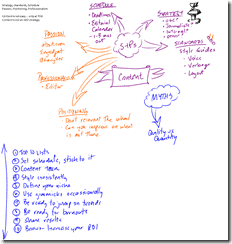
Books to Read
I started with crayons. However, it became more and more difficult to get the colors off of my laptop screen. Plus, the markup didn’t travel with the image.
Eventually, the crayons left ghosted images on the screen, like a burned plasma display.
Then, I found the pen computer. Now, I can create, markup and take notes analog style, with instant conversion to digital.
A Snapshot of Pubcon
One benefit of the modern pen computer is the ease with which analog input can be shared. So, I thought I would share some of my notes with you.
I chose these based on the following criteria:
1. I took notes
Many presenters don’t realize this, but you have to be “note-worthy.” You have to tee us up to take notes. You’re presentation has to be somewhat logically organized. You can’t throw too much at us too quickly, because we’ll just give up.
2. I was able to take notes on my computer
Props to PubCon for providing extension cords and power strips for us.
3. My notes are somewhat legible.
You be the judge.
Some People Prefer This
Some people prefer this mix of visual cue and text. You may find it helpful.
Click on any of the images to see a full-resolution version.
Some People Prefer Summaries
Here are some of the things I gleaned from notes that didn’t pass the three-point test:
Tools to Check Out
Organic Keyword Search
SEO “Quake” Plugin
SEO for Firefox
Yahoo Site Explorer
Adwords Preview Tool
ExcellentAnalytics.com (Excel)
Tatvic
SEM Rush (Mark Jackson)
Google Trends
MSN Commercial Intention Tool
validator.w3.org
Bing Webmaster Tools
Landing Pages
RingLead.com Lead Management
Social Evaluation
Quarkbase
Woopra
Trackur (Andy Beale)
Brandseye
Twitter
Twitalyzer
WeFollow
Tracking Twitter
Twellow
Twilert
Facebook Apps
Sprout Publisher
AppBank
Involver
Facebook Notes
Site Design
MeasureIt Firefox Plugin
Aardvark Firefox Plugin
Colorzilla Firefox Plugin
Firebug Firefox Plugin
Headspace2 WordPress Plugin
WordPress Themes
Thesis ($)
Flexibility 2
Corrington
Affiliate Theme
eArtisteer (random theme generator)
Video
OneTrueMedia Video Editing and hosting
TrafficGeyser (use with care)
TubeMogul
12Seconds.tv
YouTube Insight
Google TV
YouTube Wonder Wheel
Handbrake Video Compressor
Is it smart to advertise free stuff?
Conversion Marketing StrategyThe answer is, “Yes.” On December 10, I’m going to show you the techniques marketers use to make it pay, and I’m going to do it with your content.
Why, you might ask, does it make sense to use your scarce marketing dollars to advertise free stuff? The answer is this:
Many more.
Thus, if you can get the attention of someone while they’re still thinking about how to solve a problem, you can expect more of them to visit you when they ARE ready to buy.
The key is content that converts, the kind of educational, helpful, informative content that your business generates all of the time. You may say, “My business doesn’t generate any online information.” Oh, but it does.
It’s hiding in plain site. It’s in the product specifications you write. It’s in the sales presentations you’ve created. It’s in the blog posts that you’ve written. It’s in the emails that your most grateful customers have written you.
Is it smart to advertise free stuff? It’s not actually free if you’re generating leads
If you are doing lead generation, your information isn’t free. The consumer of this helpful and informative knowledge pays with their attention, with a little information about themselves and by extending you some permission – on credit – to continue conversing with them.
The key is content that converts, the kind of educational, helpful, informative content that your business generates all of the time.
The results may well be better than your benefit-oriented ad copy
If I have decided to solve my problem with a product or service like yours, a benefit- or discount-oriented ad will do the trick. However, if I am part of the much larger audience that is still “in the question,” I won’t even know how to process your offer.
Content can help me decide. It can help me make cost tradeoffs. It can help me sell a solution to my boss. It can help me understand the real cost of not solving the problem. It can help me rationalize a purchase.
Which desk drawer is your gold hiding in?
You’re invited to spend a day with me and a panel of smart marketers as we transform plain, everyday information into content that sells.
Join us on December 10 in Austin, Texas for BYOContent: The Extreme Conversion Makeover Workshop.
By the time you leave, you will know:
Join me, Apogee Search’s Alissa Ruehl, online marketing expert Jane Dueease and a room full of smart people like you as we turn ordinary information into online content that will grow our businesses.
Act before Thanksgiving, and we’ll knock $50 off the price. Breakfast, lunch, and a snack are on us.
If the Web is important to your business, this will be one of the most eye-opening events of the year.
Of course, I’d appreciate you sharing this email with other businesses, but don’t send it on until you’ve secured your own seat. I like to keep my workshops somewhat intimate.
Get the details and reserve your place in the room. This is going to be a fun one.
Best regards,
Brian Massey
Conversion and Google Maps Optimization
Conversion OptimizationThis is a guest post by Brian Combs of ionadas local.
About eighteen months ago, the SEO agency of which I was then a member was hired by a company in the travel industry. Their websites were seeing a 20% drop in traffic from Google. Even more worrisome was the nearly 25% drop in sales from Google.
Meanwhile, their keyword monitoring tools were saying everything was fine. Their tools watched several thousand keywords on a monthly basis, and the rankings had not substantively changed. If a keyword was third last month, it was third again this month.
We were tasked with determining the cause of the drop and prescribing a remedy.
The culprit was the new Google Maps business listing. These are the seven (at that point ten) listings that come up with the Google Map on queries with locational intent.
Austin plumber Sample Google Maps business listing.
Note: The example image is from a different industry than the client in order to protect the client’s identity.
These Google Maps had begun popping up for a large number of the client’s search terms. A keyword that was third in the organic listings was likely to be pushed below the fold. As a result, the traffic from Google was dropping precipitously.
And conversion was dropping at an even higher rate. Clearly, it was the best traffic that was being lost.
I would posit that this represents the biggest change to Google’s Search Engine Results Page (SERP) since they began including paid listings above the natural listings.
Does Local SEO Matter for You?
If your business needs to generate website visitors, phone calls, or foot traffic from people in particular geographies, then local SEO is likely appropriate for you.
Do your keywords include a city (or neighborhood in them)? When you search on them, is the so-called 7-pack (or any Google Map) returned?
Google is constantly enlarging the universe of keywords that generate map results. So if the map is not returned today, it may begin doing so in the future.
Google is even assuming local intent when none is expressly stated.
For instance, if you search on [coffee shop], Google will determine your location from your IP address, and return you a list of coffee shops your area.
Impact on Conversion Rate
The impact of this change by Google can hardly by overstated. Even if you’ve worked your website to the top of the organic listings, the addition of the Google Map listings will have a substantial impact on Click Through Rate (CTR) and post-click conversion rate.
While no studies have been published on this topic as yet, the assumption is that the curve of traffic decline within the seven maps listings is not as steep as it is for the ten organic listings.
Also, the company name within the Google Maps listing can have an effect. Known, branded companies certainly have an advantage. And those that are nothing but a list of keywords are likely at a conversion disadvantage.
Reviews and Their Impact on Conversion Rate
The Google Maps business listings very prominently list the reviews a company has received. These reviews may have been placed directly with Google, or may have been pulled into Google from third-party systems such as CitySearch.
Both the number and the quality of reviews within Google have an impact.
The number of reviews greatly impacts the ranking of the business listings. If all else is equal (which it never is, of course), the ranking with the greater number of reviews will be higher. A large number of reviews can overcome many other deficiencies in Google Maps optimization.
I have not seen any studies on the impact of the number of reviews on conversion, but I expect they are positively correlated. If there are two listings, one with twenty-five reviews and one with no reviews, people will tend to look at the business with reviews first.
And while the quality of reviews has little to no impact on rankings, it can certainly have a significant impact on conversions.
This is not to say that an occasional bad review is going to drive you out of business. We’ve all read reviews from clearly unreasonable people, and most people will give a company the benefit of the doubt.
But if the preponderance of reviews are negative, and the reviews seem reasonably written, you had better work to improve your product/service quality, and encourage happy customers to write reviews for you.
Brian Combs is the founder of ionadas local, a provider of Google Maps optimization in Austin, Texas. ionadas local 13359 N Hwy 183, #406-245, Austin, TX 78750, (512) 501-1875
CMO, Let My People Go
Conversion Marketing Strategy, News & EventsIt was a room full of very smart, inquisitive and curious communicators. We spent two days immersed in the challenge of giving our Web site visitors what they need, and in doing so, knew we’d be growing our businesses.
Brian Massey presenting at DMA 09.
You know the experience: you’re engaged in a conversation or a training or reading a book, and you KNOW everything you’re taking in is true. In fact, you already new much of it.
But, at work, where you’re supposed to be exercising these truths, conversations like this don’t happen. What is that all about?
We covered a lot of ground in my DMA 90 pre-conference intensive “Optimizing Your Web Site for Conversion and Business Success.” I learned a great deal from my audience.
But underneath the energy was an undertow dragging us away from shore. It was the knowledge that we would be returning to marketing departments that are understaffed, under budgeted, and — worst of all — focused on the wrong things.
I heard it from many attendees.
We don’t have the resources to do the things we need to do
Dear CMO, have you considered building an organization that doesn’t have the resources to NOT do the things you need to do? What would that look like?
Let them communicate
It would be a group of people so focused on delivering content that the prospect needs, that they wouldn’t even consider wasting time on the self-aggrandizing, posing communication that so many brands seem to treasure.
Clear the obstacles
They would sweep obstacles out of the way (this is really your job, CMO) so that they could communicate faster, with better data and known results.
They would have ways of working with IT and legal so that their communications are frequent, human and transparent.
Let them experiment
They would make many mistakes, but they would only make them once. They would know which half of their advertising wasn’t working.
Think of an entrepreneurial product development group.
Let them publish
They would produce a volume of content far greater than they do now, with greater accuracy, consistency and efficiency.
Think of a world-class newspaper.
Marketers, take the reigns
A little of the Schwag I collected at DMA 09
If you want to see the most amazing collection of schwag, go to a marketing conference. What surprised me was the amount of goodies that were given away without any qualifying activity.
This is not lead generation or even demand generation.
If you want to join a group of marketers and business owners bent on communicating, join us on December 10 in Austin, Texas for the BYO Content Extreme Conversion Makeover. You’ll soon have the leads and revenues that prove you’re a communicator.
‘Bring your most tired white papers, your most mundane articles, and your raw video. We’ll show you how to weave it into a conversion scenario that will generate leads and sales for your business.
We’ll announce the details here shortly. Don’t miss the post.