These are the stories that caught the eye of The Conversion Scientist last few weeks. If you are a curious marketer looking to learn more about conversion, please subscribe my weekly recommended reading list, For Further Study.
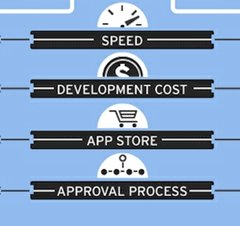
Mobile Site or Mobile App: Which Should You Build First? [INFOGRAPHIC]
I only touch on the issue of Mobile Apps in my new book Your Customer Creation Equation. So I’m happy to share this very helpful infographic on Mobile websites vs. Mobile apps.
Is it just me, or is it clear that mobile websites are the way to go (except in extreme situations)?
Buddy Media CEO Makes Unforgettable ‘We Got Bought’ Video
How is this touching video different from your corporate press release? In every way. “The Human Voice is Unmistakeable.” In Your Customer Creation Equation (coming in June) I make the point that your business should be using the content it naturally makes to feed your audience.
Clearly Michael Lazerow is good with an iPad and Keynote.
What are you good with?
How to Build and Operate a Content Marketing Machine | SEOmoz
It is a great sign that @SEOMoz included Conversion in their grand plan for Content Marketing. This infograph considers conversion a key component of content marketing, but in my upcoming book on conversion I make content a key part of conversion marketing. Different approaches, same result.
This is a guest post by Katleen Richardson of Marketing AdvantEdge
If you’ve been in business for a while and have only recently started to develop your online presence, the idea of having to measure your online marketing performance can be daunting. Even for those who have more experience in the world of conducting business online, trying to compare your online and offline measurements can seem tricky. It’s important to remember, though, that these two aspects of your marketing strategy are fundamentally the same. For both, ROI is the most important factor, and in both cases you’re going to be most interested in these core metrics:
response rate
lead conversion rate
sales conversion rate
average deal size
gross revenue
expenses
There is one aspect exclusive to online measurement that gets a little complicated, however – social media performance. Calculating your social media influence, one of the core social media metrics, can be done in a number of ways. Here’s one that works well:
volume of content x number of comments x number of shares x net reach = influence
When assessing your net reach, take the deduped audience you have across all social media channels. In other words, a person who follows you on both Facebook and Twitter is only counted as one person.
In order to get meaningful measurements across online and offline channels while, at the same time, managing your work load, start by choosing a core of five metrics that you’re going to track from month to month consistently. This creates a solid base from which to make comparisons, and will help to keep you from getting overwhelmed. Keep in mind that whatever you decide to track needs to tie back to both your marketing objectives and your overall business objectives.
Here are a couple of principles to help you tie it all together:
Make sure each offline component can be tied back to an online component. Let’s take, for example, QR codes used on brochures. If you embed QR codes with URLs created with a URL shortening service, you can then track the performance of the shortened URL. Look at the number of hits on the URL against the total distribution run of the brochures to measure the overall response rate.
Let KPI and media mix reports help steer you. These reports should be reviewed every month, both within marketing and across the company, to help you make adjustments in the course of your marketing strategy. The KPI report should include whatever metrics tie back to marketing and company goals. For the media mix report, take the metrics listed above and apply them to each of your marketing channels, including SEO, advertising, direct mail campaigns, landing pages, and so forth.
If you really want to get strong analytics in place that will cover all your bases, your best bet is most likely going to be a marketing automation system. These days, there’s no reason not to – there’s a variety of choices out there that cover a full spectrum of requirements, even if you’re on a tight budget. All you need to do is find the system that gives you the most appropriate options for your situation, and you’ll be well on your way.
The Dollar Shave video went mega viral because it is “funny”, right?
But to understand why and how it is funny you need to break it down and analyze what motional strings it is playing. Only then will you truly understand its success.
Michael is fed up. Who isn’t?
The major emotional theme of the video is “Fed up-ness”. At the heart of this Fed up-ness lies of course Dollarshave’s value proposition to customers who are fed up with paying for overpriced razor blades. But there’s more.
The whole body language of CEO Michael Dubin says “I’m fed up”. He just can’t sit or stand still, he needs to move, he’s on a mission. He’s fed up with political correctness as he proclaims that the blades are F***ing great. He’s fed up with over-paid tennis players. I think he’s even fed up with being fed up.
This goes right into the core of the American peoples’ feelings. Not only are they fed up with the Razor blade monopoly, they’re fed up with Washington, they’re fed up with no jobs. They’re also fed up with being fed up.
Michael takes matters into his own hands
By doing so he becomes an agent for the aspirations of Gillette-enslaved Americans. When they buy blades from Dollarshave, they’re not customers, they’re proactive change agents who can create change and fortune by their own actions. Together with Michael they enact their shared American dream.
Remember the payoff in the video?
“Isn’t it about time?”
It’s not a product or service statement. Actually not even a statement. It’s just about how you feel when you’re fed up and want to take matters into your own hands. Like Michael.
Michael is one of us, not one of them
Look at Michael’s office. It’s a mess. You’ll find similar offices all over the country. Except of course at Madison Avenue. It’s as far from that as you can possibly get. In any case Michael seems to spend most of his time in the warehouse.
Michael would not pay an agency tons of cash to make this video. If you know a little bit about video production you can see it’s professionally made. Still it’s created to preserve an amateurish look and feel. That’s not by coincidence.
And Michael obviously can’t play tennis.
Michael is American
Ok, the flag at the end is obvious, but when you think of it the American theme runs right through the video.
There’s an homage to the ancestors (Grandpa with Polio). The evil villain is a foreigner (a Swiss tennis player). There’s a reference to the Vanderbilts.
It might not be as obvious to you as it is to me (I’m Swedish), but it’s there for sure.
Michael talks to….. Yeah, Michaels
Michael is a former marketing exec. Does he need to save dollars on his shaving in order to be able to keep the kids in school? I don’t think so. He just thinks it’s about time.
So when crafting the video for the launch campaign Michael needed to decide what people he should appeal to. – “What is the persona of my early adopter?”, is the question he must have been asking himself.
And I think the answer is – “People like myself!”. People who think the Swiss Army knife approach of Gillette is starting to look ridiculous. People who don’t need to save on their shaving. People who just have this feeling that something should change. Not for rational money-saving reasons, but for emotional reasons.
Others will come later. Who really need to save on their shaving. Who wants more proof of the quality of the blades. Then we’ll see other campaigns designed for them. But for now Michaels want to wake up thousand of Michaels around the country.
Michael creates an Experience
I listened to Jared Spool at Conversion Conference SF a couple of months ago. He said that every innovation goes through three phases; Technology, Features and Experience, being the final one.
Gillette is clearly about Features, with their vibrating handle, flashlight, 10 blades and backscratcher (according to Michael). They’re trying to sell us a Shaving Experience which is an Experience around the use of the product.
Michael, on the other hand, spends exactly 5 seconds to talk about the features of the products in the 94 seconds video. Dollarshave creates an Experience around how we see ourselves as individuals and how we want to live our lives. This is infinitely stronger.
We react much stronger to messages about our identity than our actions. I guess Michael knows this.
So if and when you decide to buy those blades you’re not just shaving – You’re participating in a collective experience designed to enforce your self-image as a strong and active American who thinks “It’s about time”. John Ekman is the Chief Conversionista of Conversionista! He is regarded as a Swedish authority on Conversion Rate Optimization. According to John, a Conversionista is someone deeply and crazily passionate about improving Conversion Rates. You can find more inspiring posts on John’s blog.
BJ Fogg is a Psychologist, Innovator and Director, Stanford Persuasive Technology Lab. He gave an inspirational and interactive keynote presentation at Conversion Conference West 2012 using props instead of slides. His props included a magician’s robe, and a kayak paddle as a wand.
Clearly, he knows something about how to communicate. Part of his presentation involved the audience teaching his B=MAT behavioral model to not one, but two others. You’ll find that model in this instagraph that I captured in real time. FULL SIZE VERSION
At the start of 2011, I wrote about the poker hand, the winning strategy, the high cards that let you compete against every other site their customers will visit.
Creating and optimizing interesting content that helps visitors find what they need is a high card. Social media and attention to conversion metrics are cards that make you the Chris Moneymaker of the online world.
But while some companies got their hands in order in 2011, a lot of people still need to step up their game using the same strategies I suggested last year.
So welcome to 2012 and take a minute to check your hand on this ClickZ article, 11 Ways to Deal Yourself a Better Online Marketing Hand. You can even use this as a 2012 To Do list for your online presence. Happy New Year!
Groupon emails appeal to all of the buyer personalities.
Whatever you think of deals site leader Groupon, you can’t argue with their amazing success.
Since 2007, Groupon has built an email list of 50 million subscribers and have kept them enraptured even though they send an email almost every single day.
Well bacon sizzles, too, and it’s email counterpart “bacn” is the sizzle that sells your online service.
Bacn is the term for notification email, the confirmations we receive from the ever-growing online services that we sign up for.
Many sign up. Few buy.
In my up-coming book, I define the Conversion Signature “Site as a Service” and identify the key conversion strategies that make these sites successful. Service sites have an advantage: you can try the product right there on the Web. They have a disadvantage, though: two conversions to buy.
The first is converting a visitor to a “tryer” by signing them up for a demo.
The second is converting the tryer into a buyer.
Email is the underutilized weapon in this second conversion.
What Bouncy Bob, Lost Lucy, Methodical Mary and One-hit Juan will tell you about your business.
“It’s people!” Detective Thorn declared in the 70’s apocalypse flick Soylent Green.
The same can be said about analytics.
In the conversion lab, website analytics is a clinical tool, sterile in its collection of data on our visitors and their behaviors. It is capable of providing rafts of data and reams of reports over hundreds of metrics. And all of this is of little help to us in making business decisions.
I’ve given my analytics a more human face, and I think it will work for you as well.
In How to Use Advanced Segments and Custom Reports in Google Analytics [Video] I use two metrics and two helpful Google Analytics features to capture the behavior of four characters that visit our sites.
Bouncy Bob will spend below average time on the site and will visit few pages during his visit.
Like Bob, Lost Lucy will spend little time on the site, but will hit a number of pages higher than the site’s page-per-visit average. It’s like she is lost and trying to find something relevant. One-hit Juan spends a great deal of time on the site, but visits few pages. He lingers on some content before moving on.
Finally, Methodical Mary spends a great deal of time and visits many pages. This is typically considered a sign of high engagement.
Like most sites, Methodical Mary will drive the highest subscription rate. She’s engaged, staying for a long time and seeing lots of pages. She is also seeing my offers to subscribe multiple times.
Lost Lucy’s are, surprisingly, my second best visitor. She doesn’t convert at nearly the rate that Mary does, but perhaps she likes what she sees and wants to be reminded to come back when she has more time.
I would expect Bouncy Bob to have the worst conversion rate, but he beats Juan.
Juan visits an average of one page per visit, but stays for an average of more than ten minutes. What’s going on here? I suspected that he was watching one of the many videos I post on the site. But when I look at the pages that Juan frequents, I find something different: they all have links to other sites that open in a new window. The time-on-site clock is ticking while Juan checks out another site!
Juan shows us one of the pitfalls of links to other sites. If you open links to other sites in a new window, it skews your analytics reporting, and doesn’t seem to really help visitors come back to your site.
What can you learn from the people that you meet in your analytics?
Yes, you can scan the QR Code on this shoe.Give it a try.
They are remarkably simple, and yet very powerful. They can follow your content as it darts across the social media horizon. They can change the structure of the Internet in an instant. They harbor surprising functionality in a small package.
I’m talking about short URLs and their real world twin, QR codes.
It turns out that there’s a lot you can do with these little gems. They’re like little packages of digital goodness.
I explore some of the more interesting uses in Stupid Short URL Tricks: Content Swapping, QR Codes, Mobile Microsites and More.
Among the “Stupid” short URL tricks I discuss are:
Tracking Your Content Like 007
Finding Out Who Has a Crush on You
Giving Your Pages an Energy Drink
Let People Click on Real Stuff
Save on Business Card Costs
Make Short URLs Longer
Make Dogs Talk
I’ve come to rely on them for much of my social media tracking. I’ve also worked them into my clothing. Yes, you can actually scan the QR Code on the shoes to learn more about why Conversion Scientists wear a lab coat.
I’ll be sporting these shoes at PubCon Las Vegas this November. Come check them out.
Shoe design by Sloan Foster.
Brian
It’s not easy to find search marketing firms that get conversion, the part of the search marketing process that puts money in your pocket. Globe Runner SEO is one of those firms that gets conversion. Notice the questions they ask and the focus they have on conversion in this brief interview.
Here we dive into the kind of conversion strategy you need if you have a considered (long) sales cycle or a high-repeat business: relevant, frequenty, easy email.
Pardon my loopiness. I had just finished presenting to the amazing DFWSEM group. Check them out.
Join The Conversion Scientist by Email to see how it is done.
DFWSEM-Packed house for “The Chemistry of Landing Pages”
Photo courtesy @SarahBoswell

 These are the stories that caught the eye of The Conversion Scientist last few weeks. If you are a curious marketer looking to learn more about conversion, please subscribe my weekly recommended reading list, For Further Study.