In this video, four experts give free website advice to the owners of one website: Brian Massey, Andrew Davis, Josh Miles, and Todd Wheatland.
Unsolicited Advice is a short, high-energy video series in which we evaluate websites, giving tips on how to make them work.
Everyone wants to be the first listing on page one of Google for the terms that define their business. Many businesses pay dearly to maintain that position.
But what if this wasn’t necessary to get the attention of searchers? What if your third-place ranking was as powerful as being at the top of the page in terms of clicks?
This is the promise of video. Properly tagged with Open Graph meta tags, you can get a thumbnail of your video onto search pages and have more visual impact than the top listings.
[jwplayer config=”Autostart” mediaid=”2032″]
Implementing Open Graph for Video
The details can be found in my new column Use Open Graph To Get Video Thumbnails Into Your Search Results on Search Engine Land. Fellow Conversion Scientist Joel Harvey tells us his secret weapon for getting video thumbnails into search results.
If you’re curious, the Open Graph tags used on this page are:
<meta property=’og:type’ content=’movie’ />
<meta property=’og:video:width’ content=’640′ />
<meta property=’og:video:height’ content=’360′ />
<meta property=’og:video:type’ content=’application/x-shockwave-flash’ />
<meta property=’og:title’ content=’Ooooh! Video’ />
<meta property=’og:description’ content=’Use Open Graph To Get Video Thumbnails Into Your Search Results’ />
<meta property=’og:image’ content=’/wp-content/uploads/2012/07/Open-Graph-Video-thumb.png’ />
<meta property=’og:video’ content=’/wp-content/uploads/jw-player-plugin-for-wordpress/player/player.swf?file=/wp-content/uploads/2012/07/Open-Graph-Video-SEO.mp4&controlbar=none&dock=false&autostart=true&height=360&width=640′ />
There’s nothing like an arch nemesis to get the “good guys” motivated and engaged in a quest. If you are trying to get your conversion project approved, consider finding a competitor who seems to be making all the right moves.
I discuss the components of your competitor story, including appearing to have greater resources than you, appearing to be smart, and appearing to have an evil plan.
I introduce you to some Spy Equipment that tells you just how smart they are.
I show you how to tell if they are they optimizing their site, using analytics, page analyzers or testing packages.
You can also tell if they are using ratings and reviews, recommendation engine or video players.
I tell you how you can catch them monologuing, revealing their secrets.
Finally, I show you how to cast them in their best light, making them more threatening.
With a little research, you can clearly draw a picture of your competition as an evil genius, working to take food from the mouths of your family. You can develop the story of the powerful competitor using some spy equipment, their public “bragging,” and some page analysis tools. This will make your conversion project seem more critical to the survival of your business.
This is a guest post by Jason Wells of Convirza (formerly LogMyCalls), who has some interesting data on the power of phone calls – and good reasons to measure your web-influenced call traffic.
One of the byproducts of the mobile marketing explosion is an increase in the number of phone calls businesses receive. BIA/Kelsey, in a report released in mid-June, says that the number of phone calls most businesses receive will double by the end of 2013. You read that correctly. Most businesses will receive twice as many phone calls in 18 months.
It sounds staggering, but it makes sense.
Google says that 61% of mobile searches result in a phone call. xAd says that 52% of all mobile ads result in a phone call. Add those numbers to burgeoning smartphone penetration and it all equals more phone calls.
What Does this Mean For Conversions?
I can hear you, expert online marketer, panicking a bit here. Won’t this mess up your conversion rates for landing pages? Won’t it make things ‘messier’ to track if people start calling you more? Maybe. But it will also make your conversion rates go up.
Convirza tracks conversions resulting from phone calls, and here’s what our research shows us.
Inbound phone calls are 10-15 times more likely to convert than inbound web leads. In other words, someone that downloads a White Paper or attends a webinar is significantly less likely to receive a Demo of your product or buy from you than someone that calls your business.
Not surprisingly, the same BIA/Kelsey report notes that 61% of businesses rate their inbound phone calls as ‘excellent leads.’ Only 52% rate web leads as ‘excellent leads.’
Recently we ran 3 different email campaigns with 3 different advertisers. Each campaign advertised the same White Paper. Because we’re obsessed with marketing analytics, we tracked these campaigns fastidiously. We tracked how many people downloaded the White Paper and we tracked how many phone calls each landing page produced.
Here’s what we learned.
This landing page saw a 47% click conversion rate and a 50% call conversion rate.
Campaign 1 – The landing page converted at 42.1%; a respectable, 11.7% of those leads wanted a demo of our product. We also placed a phone number prominently on the landing page. That phone number produced sixteen phone calls, ten of which resulted in demos. That means 62% of the phone calls resulted in a demo. That’s higher than 11.7% :-)
Campaign 2 – The landing page converted at 40.1%. And a reasonable 13.2% of the people that downloaded the White Paper ended up receiving a demo of our product. Again, this landing page also generated phone calls. Around 50% of those phone calls resulted in demos.
Campaign 3 – The landing page converted at 47.4%. And a very, very poor 3.6% of those leads wanted a demo (this campaign was conducted very recently so we expect that number to rise). Again, over 50% of the people who called via the landing page requested a demo.
Phone conversion rates are higher. It is just that simple.
Mobile Marketing Produces Calls, Conversions
Google says that pay-per-call mobile Adwords campaigns have 6% to 8% higher conversion rates than pay-per-click mobile Adwords campaigns. They also say that including phrases like ‘Call Now’ or Call us Today’ in the mobile ad copy improves conversion rates.
Calls are king.
The reason for these higher conversion rates for mobile is simple: it is natural for mobile searchers to call. After all, they are searching on a phone. Mobile callers also enter the sales funnel at a much lower point. Mobile searchers rarely do extensive research on their mobile device. Rather, mobile users search when they are looking for something they need immediately. This means action is more likely and a phone call is more likely.
What Does All This Mean?
The first thing it means is that a landing page conversion rate is simply not as ‘clean’ as it used to be. You have to factor calls into the equation. To ignore them is to ignore the highest performing element of the landing page. And that would be silly.
Second, it means that businesses need to be staffed and prepared to answer phone calls and answer them effectively. Because, just like a landing page, small tweaks to phone pitch can make a close rate go up or down.
Third, it means that you shouldn’t measure mobile conversions in the same way you’ve measured online conversions for the last 10 years. Mobile is not about pageviews and abandon rate.
Finally, we should point out that some businesses will be impacted by mobile more than others. We recognize this. But, keep this in mind: if you have a lead type (inbound phone call) that is converting 30%, 40% or 50% of the time, why wouldn’t you want to generate more leads of that type?
These are the stories that caught the eye of The Conversion Scientist last few weeks. If you are a curious marketer looking to learn more about conversion, please subscribe my weekly recommended reading list, For Further Study.
Mobile Site or Mobile App: Which Should You Build First? [INFOGRAPHIC]
I only touch on the issue of Mobile Apps in my new book Your Customer Creation Equation. So I’m happy to share this very helpful infographic on Mobile websites vs. Mobile apps.
Is it just me, or is it clear that mobile websites are the way to go (except in extreme situations)?
Buddy Media CEO Makes Unforgettable ‘We Got Bought’ Video
How is this touching video different from your corporate press release? In every way. “The Human Voice is Unmistakeable.” In Your Customer Creation Equation (coming in June) I make the point that your business should be using the content it naturally makes to feed your audience.
Clearly Michael Lazerow is good with an iPad and Keynote.
What are you good with?
How to Build and Operate a Content Marketing Machine | SEOmoz
It is a great sign that @SEOMoz included Conversion in their grand plan for Content Marketing. This infograph considers conversion a key component of content marketing, but in my upcoming book on conversion I make content a key part of conversion marketing. Different approaches, same result.
At first, I was pleased to get my brand new copy of Landing Page Optimization Second Edition, delivered and signed by Tim Ash himself. I had learned a great deal from his first edition. It was a time in which I was adding more optimization services to my practice.
The new edition seemed to have everything. It had fresh pages from Tim plus Rich Page and Maura Ginty. It had a snazzy blue cover. Many of the graphics inside were new or updated.
And then it hit me.
Where were my dog-ears? My notes in the margins? The coffee stains on my most visited pages? The new book didn’t fall open to the places I revisited most, like the handy little “Size of Improvements” chart (now on page 302). It was all… gone.
I felt like my favorite site had been redesigned and none of my bookmarks worked. This is the downside to new editions, so I went searching for reasons to start over. It turned out to be a nice reminder of what we do and how we do it.
First of all, he still calls our baby “ugly” to highlight the need for “unflinching courage and clinical detachment” in examining your site. I guess familiarity is welcome in almost any form.
The new book has new content from Tim’s classic presentations, including “The Seven Deadly Sins of Landing Page Design” and his “Conversion Ninja Toolbox.”
I don’t know if Rich and Maura brought this characteristic, but the book has a bit less of an edge. Tim introduced his original section on “The Math of Tuning” with a section entitled “Just Grin and Bear It.” That little ditty is now gone, as is the section “A Final Warning.” The chapter from the first edition “Why Your Site is Not Perfect” has been removed and the content scattered about, as if they were trying to hide it.
Still, you can sense a little of the original edge. The chapter on “Understanding Your Audience” is now “Misunderstanding Your Visitors.” I had to jump to that one.
Just about everything is in there
The book is ambitious, and Tim, Rich and Maura do a good job of covering a lot of ground without eye-glazing detail. Of course, the discussion of factoring is still there.
The new book covers conversion improvement basics and best practices in common situations, which sets the table for the ensuing chapters. There’s a basic primer on statistics and probability. The authors address the challenges of assembling a team and getting buy-in, certainly a thornier optimization challenge than the technical issues.
The excellent chapter “Developing Your Action Plan” is there. New content on mobile websites can be found in this edition.
For me, Landing Page Optimization has been the best book in my library for successful testing, and is the one I most return to. The title may be misleading. Since every page on your site could be a landing page, it is really a book about website optimization.
The new edition offers even more without becoming cumbersome. If only I they could have preserved my “customizations” from the first edition. The next best thing to reading Landing Page Optimization is seeing Tim, Rich and Maura in person. Will you be at Conversion Conference Chicago June 25-27? It is the most interesting and educational way to get your optimization game into full swing.
Your unique online equation is a powerful tool, a tool that gives you leverage over your marketplace. It is what makes making money, generating leads and growing your business look easy.
How can this be?
There are five big reasons that companies that understand their online equation win:
They pay less for the exact same advertising as you.
They hit your prospects several times to your one touch.
Their content is about their prospects, not themselves.
They don’t make mistakes more than once.
They are waiting on search engines for your dissatisfied visitors.
This is a guest post by Katleen Richardson of Marketing AdvantEdge
If you’ve been in business for a while and have only recently started to develop your online presence, the idea of having to measure your online marketing performance can be daunting. Even for those who have more experience in the world of conducting business online, trying to compare your online and offline measurements can seem tricky. It’s important to remember, though, that these two aspects of your marketing strategy are fundamentally the same. For both, ROI is the most important factor, and in both cases you’re going to be most interested in these core metrics:
response rate
lead conversion rate
sales conversion rate
average deal size
gross revenue
expenses
There is one aspect exclusive to online measurement that gets a little complicated, however – social media performance. Calculating your social media influence, one of the core social media metrics, can be done in a number of ways. Here’s one that works well:
volume of content x number of comments x number of shares x net reach = influence
When assessing your net reach, take the deduped audience you have across all social media channels. In other words, a person who follows you on both Facebook and Twitter is only counted as one person.
In order to get meaningful measurements across online and offline channels while, at the same time, managing your work load, start by choosing a core of five metrics that you’re going to track from month to month consistently. This creates a solid base from which to make comparisons, and will help to keep you from getting overwhelmed. Keep in mind that whatever you decide to track needs to tie back to both your marketing objectives and your overall business objectives.
Here are a couple of principles to help you tie it all together:
Make sure each offline component can be tied back to an online component. Let’s take, for example, QR codes used on brochures. If you embed QR codes with URLs created with a URL shortening service, you can then track the performance of the shortened URL. Look at the number of hits on the URL against the total distribution run of the brochures to measure the overall response rate.
Let KPI and media mix reports help steer you. These reports should be reviewed every month, both within marketing and across the company, to help you make adjustments in the course of your marketing strategy. The KPI report should include whatever metrics tie back to marketing and company goals. For the media mix report, take the metrics listed above and apply them to each of your marketing channels, including SEO, advertising, direct mail campaigns, landing pages, and so forth.
If you really want to get strong analytics in place that will cover all your bases, your best bet is most likely going to be a marketing automation system. These days, there’s no reason not to – there’s a variety of choices out there that cover a full spectrum of requirements, even if you’re on a tight budget. All you need to do is find the system that gives you the most appropriate options for your situation, and you’ll be well on your way.
The Conversion Sciences Lab requires long hours of focused attention. Needless to say, we have to keep ourselves in shape to do good work. I keep my svelte shape in part by performing some physiological experiments on myself at Lifetime Fitness. The things I do would make me laugh if I was watching.
As part of Lifetime my membership, I am graced with the monthly magazine Experience L!fe. The March issue featured the article “A Plan for Happiness.”
Finally! A plan.
The plan for happiness begins with some convincing proof, citing a study by a PhD on some three-thousand people. Based on this research, the good doctor found that, “If you can prevent stress from happening by planning, you’re going to be much better off.” He offered three steps:
Make a List before you go to bed each night
Prioritize and tackle the first two or three things immediately
Break down big tasks into 15-minute chunks.
Now, if you are like me and some three-fourths of the population, you will find this list laughable. This kind of disciplined and controlled regimen works for one kind of person, but not for most of us.
Now imagine that your online business was paid based on the happiness achieved by its visitors. This one recipe would not be a very profitable, because it only appeals to one personality “mode.” Based on Myers-Briggs research, there are at least four major personality modes, or temperaments, and I discuss them in my most recent Search Engine Land column.
How would we write our happiness recipe to appeal to each of the four personality types and why do you care? First of all, you care because the job of your website is to make your visitors happy. That is when they buy from you.
The list provided by our eager PhD is ideal for the Competitive types, who are often found to be on a mission to improve their life. They are goal-oriented and disciplined.
However, our Spontaneous visitors live for impulse and action. Their plan for happiness might be:
Make a list — if you go to bed. Make your list with an Etch-a-sketch or Lite-Brite to make it fun.
Prioritize. Then ignore the prioritization and tackle the first two or three things that grab your interest in the morning.
Break down big tasks into… “Squirrel!”
Humanists, on the other hand make decisions based relationships and how something makes them feel. Their stress relief formula might be:
Make a list before you go to bed of the people you wish were snuggling with you. Text them goodnight.
Prioritize the first two or three things on someone else’s list. Tackle these for them.
Break down big tasks and have a task party with each of your friends.
Finally, our Methodicals are going to be suspicious that three steps is sufficient to solve a problem like happiness. They need information, data and detail.
Make a list before you go to bed each night.
Do a gap analysis of this list against the previous night’s list. On weekends, include a trend analysis.
Prioritize the list, but do not tackle yet.
QA the prioritized list using the list prioritization guidelines.
Complete a task requirements document (TRD) for each.
Identify resources required and procure missing materials.
Execute.
Have 15-minute progress reviews to ensure there has been no task scope creep.


Unsolicited Website Advice #1 [Video]
Conversion-Centered DesignIn this video, four experts give free website advice to the owners of one website: Brian Massey, Andrew Davis, Josh Miles, and Todd Wheatland.
Unsolicited Advice is a short, high-energy video series in which we evaluate websites, giving tips on how to make them work.
How Open Graph Makes Video Pop on the Search Engines
Conversion Marketing StrategyEveryone wants to be the first listing on page one of Google for the terms that define their business. Many businesses pay dearly to maintain that position.
But what if this wasn’t necessary to get the attention of searchers? What if your third-place ranking was as powerful as being at the top of the page in terms of clicks?
This is the promise of video. Properly tagged with Open Graph meta tags, you can get a thumbnail of your video onto search pages and have more visual impact than the top listings.
[jwplayer config=”Autostart” mediaid=”2032″]
Implementing Open Graph for Video
The details can be found in my new column Use Open Graph To Get Video Thumbnails Into Your Search Results on Search Engine Land. Fellow Conversion Scientist Joel Harvey tells us his secret weapon for getting video thumbnails into search results.
If you’re curious, the Open Graph tags used on this page are:
<meta property=’og:video:width’ content=’640′ />
<meta property=’og:video:height’ content=’360′ />
<meta property=’og:video:type’ content=’application/x-shockwave-flash’ />
<meta property=’og:title’ content=’Ooooh! Video’ />
<meta property=’og:description’ content=’Use Open Graph To Get Video Thumbnails Into Your Search Results’ />
<meta property=’og:image’ content=’/wp-content/uploads/2012/07/Open-Graph-Video-thumb.png’ />
<meta property=’og:video’ content=’/wp-content/uploads/jw-player-plugin-for-wordpress/player/player.swf?file=/wp-content/uploads/2012/07/Open-Graph-Video-SEO.mp4&controlbar=none&dock=false&autostart=true&height=360&width=640′ />
Listen to the Article:
Podcast: Play in new window | Download
[bookpromo]
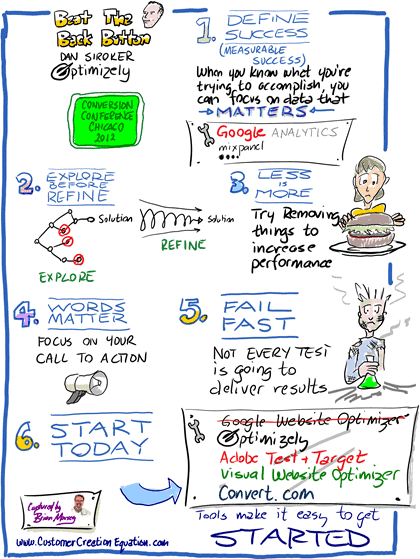
Dan Siroker: Beat the Back Button [INFOGRAPHIC]
CRO Tests | Multivariate | AB TestingDan Siroker, Founder of testing platform Optimizely offers six key ways to improve the conversion performance of your pages. This was captured live at the Conversion Conference Chicago 2012 by yours truly.
CLICK TO ENLARGE
More Infographics
[bookpromo]
To Get Your Conversion Project Approved, Find an Enemy
Conversion Marketing StrategyThere’s nothing like an arch nemesis to get the “good guys” motivated and engaged in a quest. If you are trying to get your conversion project approved, consider finding a competitor who seems to be making all the right moves.
This is the topic of my new column on Search Engine Land How To Get Management Excited About Conversion Optimization. In it I talk about the power of an enemy.
I discuss the components of your competitor story, including appearing to have greater resources than you, appearing to be smart, and appearing to have an evil plan.
I introduce you to some Spy Equipment that tells you just how smart they are.
I show you how to tell if they are they optimizing their site, using analytics, page analyzers or testing packages.
You can also tell if they are using ratings and reviews, recommendation engine or video players.
I tell you how you can catch them monologuing, revealing their secrets.
Finally, I show you how to cast them in their best light, making them more threatening.
Read the full article.
Mobile Phone Calls = Higher Conversion Rates
Lead GenerationThis is a guest post by Jason Wells of Convirza (formerly LogMyCalls), who has some interesting data on the power of phone calls – and good reasons to measure your web-influenced call traffic.
One of the byproducts of the mobile marketing explosion is an increase in the number of phone calls businesses receive. BIA/Kelsey, in a report released in mid-June, says that the number of phone calls most businesses receive will double by the end of 2013. You read that correctly. Most businesses will receive twice as many phone calls in 18 months.
It sounds staggering, but it makes sense.
Google says that 61% of mobile searches result in a phone call. xAd says that 52% of all mobile ads result in a phone call. Add those numbers to burgeoning smartphone penetration and it all equals more phone calls.
What Does this Mean For Conversions?
I can hear you, expert online marketer, panicking a bit here. Won’t this mess up your conversion rates for landing pages? Won’t it make things ‘messier’ to track if people start calling you more? Maybe. But it will also make your conversion rates go up.
Convirza tracks conversions resulting from phone calls, and here’s what our research shows us.
Inbound phone calls are 10-15 times more likely to convert than inbound web leads. In other words, someone that downloads a White Paper or attends a webinar is significantly less likely to receive a Demo of your product or buy from you than someone that calls your business.
Not surprisingly, the same BIA/Kelsey report notes that 61% of businesses rate their inbound phone calls as ‘excellent leads.’ Only 52% rate web leads as ‘excellent leads.’
Recently we ran 3 different email campaigns with 3 different advertisers. Each campaign advertised the same White Paper. Because we’re obsessed with marketing analytics, we tracked these campaigns fastidiously. We tracked how many people downloaded the White Paper and we tracked how many phone calls each landing page produced.
Here’s what we learned.
This landing page saw a 47% click conversion rate and a 50% call conversion rate.
Campaign 1 – The landing page converted at 42.1%; a respectable, 11.7% of those leads wanted a demo of our product. We also placed a phone number prominently on the landing page. That phone number produced sixteen phone calls, ten of which resulted in demos. That means 62% of the phone calls resulted in a demo. That’s higher than 11.7% :-)
Campaign 2 – The landing page converted at 40.1%. And a reasonable 13.2% of the people that downloaded the White Paper ended up receiving a demo of our product. Again, this landing page also generated phone calls. Around 50% of those phone calls resulted in demos.
Campaign 3 – The landing page converted at 47.4%. And a very, very poor 3.6% of those leads wanted a demo (this campaign was conducted very recently so we expect that number to rise). Again, over 50% of the people who called via the landing page requested a demo.
Phone conversion rates are higher. It is just that simple.
Mobile Marketing Produces Calls, Conversions
Google says that pay-per-call mobile Adwords campaigns have 6% to 8% higher conversion rates than pay-per-click mobile Adwords campaigns. They also say that including phrases like ‘Call Now’ or Call us Today’ in the mobile ad copy improves conversion rates.
Calls are king.
The reason for these higher conversion rates for mobile is simple: it is natural for mobile searchers to call. After all, they are searching on a phone. Mobile callers also enter the sales funnel at a much lower point. Mobile searchers rarely do extensive research on their mobile device. Rather, mobile users search when they are looking for something they need immediately. This means action is more likely and a phone call is more likely.
What Does All This Mean?
The first thing it means is that a landing page conversion rate is simply not as ‘clean’ as it used to be. You have to factor calls into the equation. To ignore them is to ignore the highest performing element of the landing page. And that would be silly.
Second, it means that businesses need to be staffed and prepared to answer phone calls and answer them effectively. Because, just like a landing page, small tweaks to phone pitch can make a close rate go up or down.
Third, it means that you shouldn’t measure mobile conversions in the same way you’ve measured online conversions for the last 10 years. Mobile is not about pageviews and abandon rate.
Finally, we should point out that some businesses will be impacted by mobile more than others. We recognize this. But, keep this in mind: if you have a lead type (inbound phone call) that is converting 30%, 40% or 50% of the time, why wouldn’t you want to generate more leads of that type?
Mobile Apps, Mobile Email, Infographs and Viral Video Formulae: For Further Study
Conversion Marketing StrategyMobile Site or Mobile App: Which Should You Build First? [INFOGRAPHIC]
I only touch on the issue of Mobile Apps in my new book Your Customer Creation Equation. So I’m happy to share this very helpful infographic on Mobile websites vs. Mobile apps.
Is it just me, or is it clear that mobile websites are the way to go (except in extreme situations)?
Buddy Media CEO Makes Unforgettable ‘We Got Bought’ Video
How is this touching video different from your corporate press release? In every way. “The Human Voice is Unmistakeable.” In Your Customer Creation Equation (coming in June) I make the point that your business should be using the content it naturally makes to feed your audience.
Clearly Michael Lazerow is good with an iPad and Keynote.
What are you good with?
How to Build and Operate a Content Marketing Machine | SEOmoz
It is a great sign that @SEOMoz included Conversion in their grand plan for Content Marketing. This infograph considers conversion a key component of content marketing, but in my upcoming book on conversion I make content a key part of conversion marketing. Different approaches, same result.
Enjoy the Infograph.
Review: Landing Page Optimization Second Edition
Landing Page OptimizationThe new edition seemed to have everything. It had fresh pages from Tim plus Rich Page and Maura Ginty. It had a snazzy blue cover. Many of the graphics inside were new or updated.
And then it hit me.
Where were my dog-ears? My notes in the margins? The coffee stains on my most visited pages? The new book didn’t fall open to the places I revisited most, like the handy little “Size of Improvements” chart (now on page 302). It was all… gone.
I felt like my favorite site had been redesigned and none of my bookmarks worked. This is the downside to new editions, so I went searching for reasons to start over. It turned out to be a nice reminder of what we do and how we do it.
First of all, he still calls our baby “ugly” to highlight the need for “unflinching courage and clinical detachment” in examining your site. I guess familiarity is welcome in almost any form.
The new book has new content from Tim’s classic presentations, including “The Seven Deadly Sins of Landing Page Design” and his “Conversion Ninja Toolbox.”
Meet the authors at Conversion Conference Chicago, June 25-27.
Less of an edge
I don’t know if Rich and Maura brought this characteristic, but the book has a bit less of an edge. Tim introduced his original section on “The Math of Tuning” with a section entitled “Just Grin and Bear It.” That little ditty is now gone, as is the section “A Final Warning.” The chapter from the first edition “Why Your Site is Not Perfect” has been removed and the content scattered about, as if they were trying to hide it.
Still, you can sense a little of the original edge. The chapter on “Understanding Your Audience” is now “Misunderstanding Your Visitors.” I had to jump to that one.
Just about everything is in there
The book is ambitious, and Tim, Rich and Maura do a good job of covering a lot of ground without eye-glazing detail. Of course, the discussion of factoring is still there.

The new book covers conversion improvement basics and best practices in common situations, which sets the table for the ensuing chapters. There’s a basic primer on statistics and probability. The authors address the challenges of assembling a team and getting buy-in, certainly a thornier optimization challenge than the technical issues.
The excellent chapter “Developing Your Action Plan” is there. New content on mobile websites can be found in this edition.
For me, Landing Page Optimization has been the best book in my library for successful testing, and is the one I most return to. The title may be misleading. Since every page on your site could be a landing page, it is really a book about website optimization.
The new edition offers even more without becoming cumbersome. If only I they could have preserved my “customizations” from the first edition.
5 Ways Conversion Makes Winning Look Easy
CRO Tests | Multivariate | AB TestingYour unique online equation is a powerful tool, a tool that gives you leverage over your marketplace. It is what makes making money, generating leads and growing your business look easy.
How can this be?
There are five big reasons that companies that understand their online equation win:
There are two ways to learn more about these five advantages in my new Search Engine Land column 5 Ways Conversion Takes Market Share Like Candy From A Baby.
My book, Your Customer Creation Equation.
Making the Connection between Online and Offline Analytics
Conversion Marketing StrategyThis is a guest post by Katleen Richardson of Marketing AdvantEdge
If you’ve been in business for a while and have only recently started to develop your online presence, the idea of having to measure your online marketing performance can be daunting. Even for those who have more experience in the world of conducting business online, trying to compare your online and offline measurements can seem tricky. It’s important to remember, though, that these two aspects of your marketing strategy are fundamentally the same. For both, ROI is the most important factor, and in both cases you’re going to be most interested in these core metrics:
There is one aspect exclusive to online measurement that gets a little complicated, however – social media performance. Calculating your social media influence, one of the core social media metrics, can be done in a number of ways. Here’s one that works well:
volume of content x number of comments x number of shares x net reach = influence
When assessing your net reach, take the deduped audience you have across all social media channels. In other words, a person who follows you on both Facebook and Twitter is only counted as one person.
In order to get meaningful measurements across online and offline channels while, at the same time, managing your work load, start by choosing a core of five metrics that you’re going to track from month to month consistently. This creates a solid base from which to make comparisons, and will help to keep you from getting overwhelmed. Keep in mind that whatever you decide to track needs to tie back to both your marketing objectives and your overall business objectives.
Here are a couple of principles to help you tie it all together:
If you really want to get strong analytics in place that will cover all your bases, your best bet is most likely going to be a marketing automation system. These days, there’s no reason not to – there’s a variety of choices out there that cover a full spectrum of requirements, even if you’re on a tight budget. All you need to do is find the system that gives you the most appropriate options for your situation, and you’ll be well on your way.
Happiness Means Different Things to Your Website Visitors
Conversion-Centered DesignThe Conversion Sciences Lab requires long hours of focused attention. Needless to say, we have to keep ourselves in shape to do good work. I keep my svelte shape in part by performing some physiological experiments on myself at Lifetime Fitness. The things I do would make me laugh if I was watching.
Finally! A plan.
The plan for happiness begins with some convincing proof, citing a study by a PhD on some three-thousand people. Based on this research, the good doctor found that, “If you can prevent stress from happening by planning, you’re going to be much better off.” He offered three steps:
Now, if you are like me and some three-fourths of the population, you will find this list laughable. This kind of disciplined and controlled regimen works for one kind of person, but not for most of us.
Now imagine that your online business was paid based on the happiness achieved by its visitors. This one recipe would not be a very profitable, because it only appeals to one personality “mode.” Based on Myers-Briggs research, there are at least four major personality modes, or temperaments, and I discuss them in my most recent Search Engine Land column.
How would we write our happiness recipe to appeal to each of the four personality types and why do you care? First of all, you care because the job of your website is to make your visitors happy. That is when they buy from you.
The list provided by our eager PhD is ideal for the Competitive types, who are often found to be on a mission to improve their life. They are goal-oriented and disciplined.
However, our Spontaneous visitors live for impulse and action. Their plan for happiness might be:
Humanists, on the other hand make decisions based relationships and how something makes them feel. Their stress relief formula might be:
Finally, our Methodicals are going to be suspicious that three steps is sufficient to solve a problem like happiness. They need information, data and detail.
Do you identify with any of these? Tell us in the comments. Read more about them in Advanced Landing Page Techniques: Searcher Personas. They are the modes of persuasion that the Eisenberg brothers define in their book Waiting for Your Cat to Bark? which I highly recommend.
How is your site making its case to the four kinds of visitors you have coming to your site?