
Your Traffic Fell 30 Percent. Your Targets Did Not.
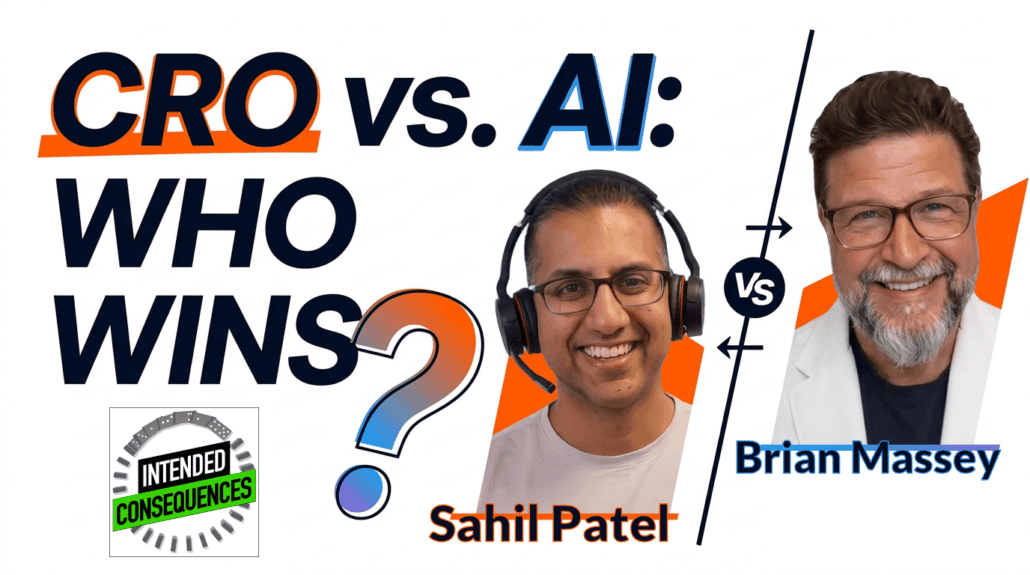
Twenty to thirty percent of the organic traffic arriving at B2B websites has evaporated. Sahil Patel does not think it is coming back.
Sahil runs Spiralyze, one of the largest conversion optimization agencies in the business, with more than 170 people across sixteen countries. Conversion Sciences has stayed deliberately small for almost twenty years.
Two agencies that took opposite roads on nearly every decision a founder gets to make, which is what makes the conversation worth an hour.
The surprise is how much the two of them still agree on. What follows is what came out of it, starting with a number that belongs on the wall of every B2B marketing team.
🎧 Listen to the full episode here:
Podcast: Play in new window | Download
The denominator shrank and nothing else did
Ask Sahil whether the SaaSpocalypse everyone predicts is real or mostly noise, and he goes straight to the traffic.
“I think the first layer of that palpable fear is that 20 to 30% of their organic traffic has evaporated,” he said. “And it’s probably not coming back.”
For every thousand people come to your website, let’s say roughly a hundred of them were ready to raise a hand. Some of those people wanted to talk to a sales rep. Some wanted to start a free trial. A large group in the middle wanted something in between, an interactive demo or a real look at how the product works, a hopeful request for a report.
Then only eight hundred people come to your site instead of a thousand. You are still converting roughly ten percent of them, so eighty people raise a hand instead of a hundred. Nothing about your website got worse. Your team did not get worse. The denominator shrank.
“Your cost structure hasn’t shrunk, your growth targets haven’t shrunk,” Sahil said. “If anything, they’ve gone up and your job has gotten harder.”
You are carrying the same payroll and the same overhead against twenty percent fewer opportunities, and you are being asked for more of them than last year. A marketing team that executes exactly as well as it did twelve months ago now posts a shortfall, and that shortfall arrives looking like a performance problem when it is actually an arithmetic problem.
Asking the barber if you need a haircut
Asking two CROs if CRO matters is like asking your barber if you need a haircut. “The answer’s always yes,” says Sahil.
Nonetheless, optimization matters more now than it did when traffic was cheap. There are fewer humans coming to the site, and each visitor has to carry more of the revenue.
On this point, there was agreement.
If human visitors are becoming scarce, then the cost of losing one to a confusing form, an unanswered objection, or a page that buries the value proposition rises in direct proportion to the scarcity.
That is not a sales pitch. It follows from the same arithmetic as the section above. Scarcity raises the value of the asset, and right now the asset is the visitor who is still showing up.
As Sahil put it, “human beings come to your website, you better do a damn good job of converting them once they get there, because they’re increasingly rare.”
Coin operated, or structurally better
The most useful idea in the whole hour is a test for where to invest your marketing dollar.
An ad campaign is coin operated. You put a coin in, something comes out, and the moment you stop feeding it the output stops. There is nothing wrong with that, and most businesses need it.
But it has diminishing returns and it never compounds. What is ending is the era when traffic in general behaved that way.
“I think for a long time in B2B, getting more people coming, we took it for granted,” Sahil said. “It was hard, it was expensive, but you could mint traffic. It was coin operated. You put a coin in Google AdWords and it works. Or you did SEO, whatever that means to you. It was kind of coin operated.”
That machine is getting more expensive and less reliable every quarter.
Optimization is a different kind of investment.
With CRO “you’re actually structurally improving your business,” he said. “You’re going to fundamentally convert traffic at a higher rate. That’s a great payoff. There’s just not that many things you can do that.”
Raise the rate at which visitors convert and every dollar of traffic bought from that day forward is worth more, including the traffic already being paid for. It does not switch off when the spending stops.
If you have never worked out, you will see real results from a twenty minute walk three times a week. If you have dabbled — some pushups, a little jogging — you have already seen a small benefit, and that small benefit is the dangerous part. It convinces you that you know where the ceiling is.
What you don’t know is, what if you really did the work. Do some pull-ups. Pay attention to your diet. Put in the cardio every morning. Add a little resistance training. How much better could you be? “I think that’s CRO.”
Most companies are in the dabbling phase. They ran some tests, saw a lift, and concluded that testing produces small lifts.
The advantage of CRO is that you can hire someone to do the work for you and get the full benefit.
Could a CRO program get your business in shape? Learn about our fully managed Conversion Optimization Services.
The next crossover is agents
We’ve seen a traffic crossover happen once already, and it was not gradual.
When we started testing, almost everything was desktop. We had a wide screen to work with and a decade of design conventions to draw on.
Then, at client after client, mobile traffic crossed the line, exceeding desktop traffic. That was a fundamental shift in how you design a web page. A shrunken version of a desktop page would no longer work. Plenty of teams did not believe it at the time, and if I am honest, I am not sure a majority of sites have fully made the shift even now.
The same thing is going to happen with agents. There will be a point where traffic from agents crosses traffic from people. For ecommerce sites doing a redesign in 2026 are going to have to redesign in 2027, because ten or twenty or twenty-five percent of the visitors will not be human.
Somebody is going to build the agent that is easy-to-use, reliable, and fun. This will be the Friendster-to-Facebook moment for this category.
Sahil is more skeptical. He is not sold on the version of the future where people research, read and buy entirely inside a chat tool.
“That’s where I would say there’s a, ‘we’ll see,'” he said. “People are very quick to say there’s not gonna be any more websites or it’s just gonna be agents talking to each other wherever agents go to hang out when we’re sleeping. Maybe, but I would [say] it’s too early to tell.”
Anyone old enough to remember the early internet and the early days of Amazon should be humble here. Nobody could have predicted in 1999 what Amazon would become.
The difference is the speed with which LLMs are changing the digital landscape. We had ten years to figure out what the internet was going to be, and twenty-five years for Amazon to become what it is. This time the runway looks more like “ten months.” That is exciting, and also a little nerve-racking.
It is the reason to build the muscle before you need it rather than after.
Why generated test ideas are so cheerful
Anyone running an optimization program is getting pitched by the same companies. They will generate twenty-five test hypotheses for your site and rank them for you.
In my experience, most of what comes back is not testable. The ideas start heuristically from whatever is on the page, and the majority are either things worth simply fixing without an experiment or things not worth the traffic at all.
Sahil’s diagnosis is that it is a data problem rather than a language model problem.
“Claude thinks every AB test is a winner,” he said. “It thinks every idea is a good idea, not just because it’s eternally optimistic, but because it’s largely been trained on the public data set.” His team went and looked at the case studies the model tends to reference. There are about 213 of them. Of those 213, 211 are winning tests.
Claude has “Winner’s Curse,” he said. “It only knows what’s winning. It’s only interviewed the World Series winners.”
That is the peer review problem wearing different clothes. Clinical trials that fail don’t get published, so the published literature systematically overstates what works. Anyone reading only the literature walks away with a distorted picture of the field.
Sahil’s wife is a scientist at the CDC.
He points out that the FDA rightly sets a high bar for what goes into a human body, and only medicine that works should get there. But the scientists themselves spend as much time studying what did not work as what did, and often more.
What you need in order to prioritize a testing roadmap is a distribution of outcomes, wins and losses together, at enough volume to see how often a pattern actually repeats.
Our industry publishes almost none of the losses.
There are periodic calls to share losing tests and Sahil notes they are few and far between. Neither agency in this conversation has a clean record on it. Losing tests get published when they make a point, and rarely otherwise.
What to ask any optimization vendor
Given all of this, what should a company ask of a CRO agency?
His standard comes from medicine. If someone hands you a cough medicine, you ask whether it has been tried, on whom, and how often it worked. We do that instinctively for things we put in our bodies, and we accept that some trials are well run and some are not. We do almost none of it for the things we put on our websites.
“It’s amazing how much is pseudoscience and anecdotes dressed up as best practice,” he said about websites.
So there are three questions to ask about any recommendation, template, or best practice you are handed.
How many times has this been tested.
How much traffic was tested against it.
How often does it win.
“Is it a repeatable outcome?” Sahil said. “Nothing works all the time. But I think that’s a very reasonable bar to ask someone, and if their answer is evasive, I think it may be a sign that they don’t have that, because it actually hasn’t been shown to be repeatable.”
Turn the question around: Ask what your agency is doing to make the process more efficient, and then ask whether they are going to let you see what your business is actually doing.
Analytics is how you walk around your website the way you would walk around a store, watching where people buy and how they are being handled at the counter. Can you get that at a granular level, on demand, without filing a request?
This is the one place where the language models have genuinely delivered. Analytics and reporting capability has gone through the roof in the last twelve months.
Clients hire an optimization team because they want more revenue from the traffic they already have. They stay because somebody is watching their back, helping them understand their visitors. They’re revealing language and offers from the landing page that they can take to their ads, their emails, and their social posts.
What did not change
Two things won’t change in this new era.
The first is that you measure what people do, not what they say. “There’s a difference between what people say they will do and what they will do,” Sahil said. “And AB testing measures the second thing.”
Conversion Sciences sees your website as a giant focus group made up of people who have already signaled that they are interested in what you do.
Put those same people in a room and ask which design they prefer and you will get confident, articulate, useless answers. We are all excellent rationalization engines. Watch what they actually do and you will learn much more, continuously, for free.
Video is a good example.
Where you place a video is important. Put a video on a conversion page and it competes with the primary call to action, which as Sahil put it creates an exit ramp at exactly the wrong moment. It gives the visitor something to do instead of filling out the form.
Put it on a solution page, where the visitor has already said they want to understand how the thing works, and it helps them take the next step.
Conversion Sciences testing adds one refinement. The title card is what moves the conversion rate. A better title card will not get more people to press play, but it will convert more of the people who see it.
The second thing that did not change is that unscalable work still pays. Sahil deliberately does a few things every month that make no economic sense at his size. “I like to go see customers in person,” he said. “It’s super expensive. I could talk to six of them in a day on Zoom versus flying somewhere and talking to one, but I still think it’s important to do it.”
That is the scarcity argument from earlier in this post, applied to people instead of pageviews. As agents absorb more of the routine contact in a customer relationship, showing up in person becomes rarer, and rarer means worth more.
💡 Talk to a Conversion Scientist about what your traffic is worth now.
🔬 Learn more about our Conversion Rate Optimization services.
Links
A note on how this was made: a language model produced the first draft of this post from the episode transcript, and a human being edited it before publication. All quotes are verbatim from the recorded conversation.

Expertise: conversion rate optimization, AB testing, marketing strategy, digital marketing, analytics, landing page design, computer programming, entrepreneurship
Speaking: IBM, Inbound, LeadsCon, Content Marketing World, Affiliate Summit, and more
Books and Training: Your Conversion Creation Equation, Video CRO, Marketing Videos that Convert, CRO Best Practices
As Seen On: ClickZ, Search Engine Land, Marketing Land, Conversion Sciences Blog, Intended Consequences podcast
Education: Texas A&M University, BS Computer Science and Management
- Your Traffic Fell 30 Percent. Your Targets Did Not. - September 3, 2026
- How to Filter Bot Traffic in Google Analytics With Ask Advisor - August 20, 2026
- Using AI to Chat with your Online Business - July 10, 2026


