
What Is Behavioral Science and How it Changed Website Design
Let’s explore the meaning of behavioral science and why it’s so important — more so, critical — to website design and increased conversions.
As data becomes cheaper and more accessible, behavioral science becomes an increasingly important term for anyone serious about marketing and conversion optimization.
Examples of Behavioral Science in our Everyday Lives
Many people think of behavioral science as a field of academic study or the domain of dedicated data scientists, but it’s much broader in scope than that.
In fact… it’s everywhere you look:
- When you check to see how many people liked your most recent Facebook post, you’re using behavioral science.
- When you decided to buy a certain pair of shoes based on their star rating, you were using behavioral science.
- When you chose not to buy that espresso machine because of the reviews, you were using behavioral science.
The Billboard music charts, the New York Times Bestseller list, the Rotten Tomatoes Freshness Score, social proof, the laugh track on The Big Bang Effect. Behavioral science affects our thoughts and decision making on a daily basis.
So what is behavioral science? How did it change the website design process? And why is it a MAJOR key to increasing a website’s conversion rate?
If you’d like to learn more, watch my presentation on using behavioral science to improve conversions.
What Is Behavioral Science?
The simplest definition of behavioral science is that it’s the study of human behavior. For those of us in the digital marketing profession, behavioral science is the science of predicting the future. Understanding how people have behaved in the past will help us understand how people will behave in the future.
It encapsulates multiple fields of study, including psychology, sociology, social neuroscience, and cognitive science, and many others, and it focuses primarily on controlled observation of behavior patterns in response to external stimuli.
Behavioral science differentiates itself from fields like social science in that it is driven by rigorously obtained empirical data, and this data-driven approach is what led us to fall in love with the field here at Conversion Sciences.
Why Behavioral Science Is Instrumental In Website Redesign And Conversion Rate Optimization (CRO)
In the early years of last century (no, not the 1900’s), I was a corporate marketer responsible for generating leads and sales from the relatively new worldwide web. It was my job to create advertising, compose the emails, design the landing pages, develop the content and build the website that would attract people to us and convert these visitors into leads when they arrived at the website.
It was a frustrating job.
Because in the digital world you can do anything. Any image, any copy of any length. I could add video, animations, live chat, ratings and reviews.
Sometimes I would mash the best ideas together into a mush that only served to confused my readers.
Other times, I would have to pick one consistent message. But was it the best one? Really? I didn’t know.
This is why the carousel was born. Marketers couldn’t decide what to put on their home pages, so they just rotated through a bunch of options.
Not a good plan.
This was all frustrating because my only form of research was “launch and see.”
Launch and see (also called “launch and pray”) is the most expensive way of collecting behavioral data. An entire design has to be completed and launched before we have ANY idea if it will work.
Redesigns have become the primary way businesses test their websites: spend a lot of money, launch and see.
Analyzing Behavior to Increase Website Conversions
Fortunately, I’ve got mad programmer skillz. I wrote a little program that collected data on my visitors. Whenever they arrived at my website, I would store the source of their visit and then track them to see if they completed a form. At the time, I didn’t even know that this was called a conversion.
With this simple program, I was able to track and measure how visitors interacted on our website. I now had data with which to make informed decisions about our site content.
In 2005, Google released Google Analytics, and suddenly, an entire new realm of online behavioral science data was opened up to webmasters at no cost.
Discover How Behavioral Science Can Help Get More Website Conversions
In 2014, Marks & Spencer redesigned their apparel website. Marks & Spencer is a GBP10 billion company running food and apparel stores in the UK and Europe. In 2013 13% of their sales went through the web. That’s about $1.5 billion. With a B.
In 2014, they launched a website redesign. The effort cost GBP150 million. Today that would be about $180 million.

After two years and approximately $180 million spent, Marks and Spencer launched a new website. Source: Digital Tonic.
The UX community–and their designers–thought the redesign was “positive.”
More research would be needed for us to give a thorough UX opinion but our first thoughts are that it’s a positive redesign.
— ExperienceSolutions
The customers didn’t agree. Upon launch, the site saw an immediate 8% drop in sales. That’s about $10 million per month in lost sales. This number doesn’t take into account the loss of brand trust.
The best way to build brand online is to deliver what your visitors want.
For $180 million, we expect that they did a great deal of research into their customers and visitors. So, what went wrong?
This is the battle being waged in your business. Intuition vs. research. Best practices vs. behavioral science. Left brain vs. right brain. Both are necessary. But if you continue to find yourself struggling to get value from the visitors that you pay to bring to your site, there is an imbalance.
Intuition is our ability to apply our experience to new situations. We admire those who can discern the important aspects of something without study.
When behavioral data was expensive to acquire, most campaign planning and development time was spent in the domain of intuition. Any research was done at the beginning of the process, and this was primarily qualitative data based on surveys and focus groups.
Then the designers and developers applied the data to the best of their ability relying heavily on their intuition to make thousands of little decisions necessary to complete a project.
The “Mad Men” way of designing a website.
It is at the end of this process that true behavioral data is collected. It’s called results. If the results were positive, then the campaign can be replicated and continued. If the results were disappointing, then the campaign would be scratched, and the process would start over.
This is the classic launch and see approach.
What Using Behavioral Science Data in Website Development Looks Like
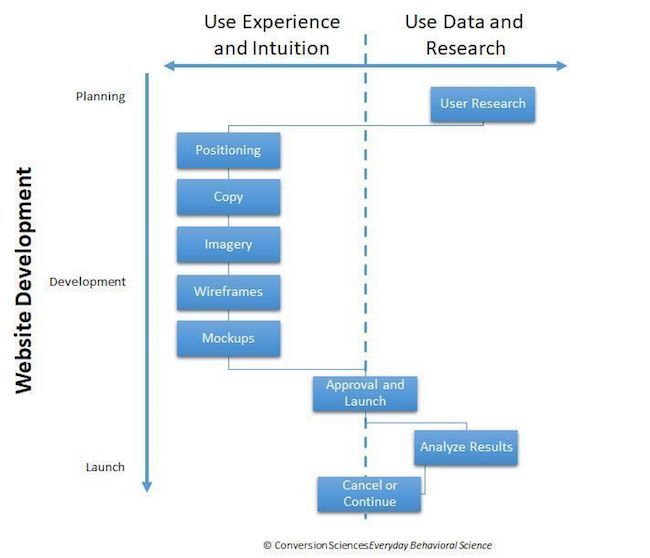
What does a campaign development process look like in an era of cheap behavioral data. For most businesses, it looks the same. But for industry leaders, it looks like this:

This is how we design a website when data is abundant and cheap. Like today.
Qualitative data is collected at the beginning. But now we can go back and test components of the campaign again and again. And we collect inexpensive quantitative behavioral data.
Intuition has its place and always will. But now we have balance. At several points along the development path, we can answer specific questions about our campaign.
Conclusion: How to Apply Behavioral Science to Increase Website Conversions
Every marketer will need to add behavioral science in their diet. What is behavioral science and how does it lead to winning campaigns?
We’re going to be diving deeper into behavioral sciences in the coming months.
We’ll be discussing the rules of behavioral science, examining case studies, and providing practical strategies for application.
If you’d like to learn more, watch my presentation on using behavioral science for your business.

Expertise: conversion rate optimization, AB testing, marketing strategy, digital marketing, analytics, landing page design, computer programming, entrepreneurship
Speaking: IBM, Inbound, LeadsCon, Content Marketing World, Affiliate Summit, and more
Books and Training: Your Conversion Creation Equation, Video CRO, Marketing Videos that Convert, CRO Best Practices
As Seen On: ClickZ, Search Engine Land, Marketing Land, Conversion Sciences Blog, Intended Consequences podcast
Education: Texas A&M University, BS Computer Science and Management
- Your Traffic Fell 30 Percent. Your Targets Did Not. - September 3, 2026
- How to Filter Bot Traffic in Google Analytics With Ask Advisor - August 20, 2026
- Using AI to Chat with your Online Business - July 10, 2026


Thank you so much for this excellent post, Brian. You write about behavioural science with such clarity!
And this makes total sense:
“This is why the carousel was born. Marketers couldn’t decide what to put on their home pages, so they just rotated through a bunch of options.”
Thank you, Brian.
Jaseem, I’m speechless. Thanks so much for your kind words.